
Story
BioMérieux Most Exposed to China's New Lab-Fee Reforms, Morgan Stanley Says
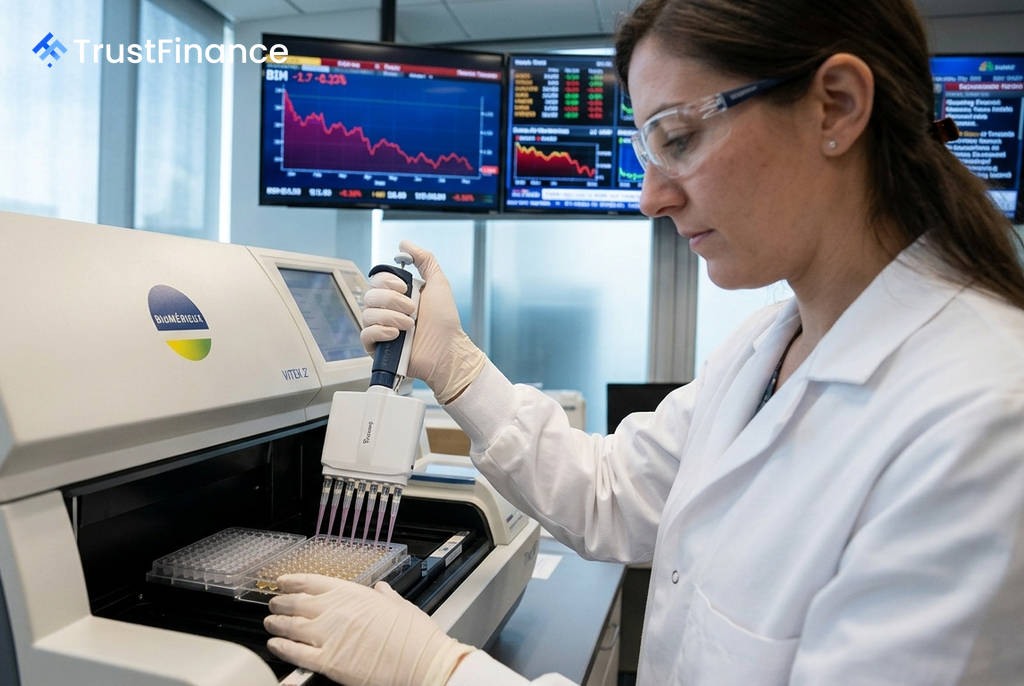
Morgan Stanley has analyzed the potential financial impact of China's new laboratory-fee reforms on major European diagnostics companies, identifying bioMérieux as the most exposed to the pricing pressure. The investment bank's report follows an August 14 announcement from China's National Healthcare Security Administration (NHSA) detailing a new policy covering more than 600 test reagents and analytes.
China's Pricing Overhaul
The reform introduces significant pricing changes for lab tests. In its base case scenario, Morgan Stanley assumes a 15% net price compression for the affected products. Analysts at the bank noted this is below the headline 20%-40% multiplex-discount range, as they expect the impact to be partially offset by increased testing volumes and the use of premium add-on services.
Company-Specific Exposure
Morgan Stanley estimated the potential impact on each company's fiscal year 2027 earnings before interest and taxes (EBIT), assuming a 100% drop-through from the price cuts. The analysis ranks the companies' exposure as follows:
- bioMérieux: The French firm faces the highest risk, with a potential 5% hit to FY27 EBIT. China represents about 5% of its group sales.
- DiaSorin: The Italian company is ranked second, with an estimated 2% EBIT impact. China accounts for approximately 3% of its sales.
- Siemens Healthineers & Qiagen: Both companies are estimated to have the lowest exposure, with a potential 1% impact on group EBIT each.
 Ad
Business Line Risks and Mitigating Factors
For bioMérieux, the exposure is concentrated in its Microbiology and Immunoassay segments, specifically its BACT/ALERT and VITEK platforms. While its dominant market share in China could limit customers from switching to rivals, the bank noted the company has already experienced weaker dynamics in the region.
DiaSorin has already guided for a €5 million impact from China's separate volume-based procurement (VBP) initiative in 2026 and previously closed its Shanghai manufacturing site. In contrast, Qiagen is seen as potentially better insulated due to its wide range of premium molecular add-ons, which could cushion the pricing impact on its molecular tests.
Despite having the highest share of Diagnostics sales from China among the four companies at 7%, Siemens Healthineers' group-level EBIT impact is estimated at just 1%. However, Morgan Stanley cautioned that this segment-level sensitivity could be understated due to the division's already-low margins and a planned corporate carve-out of the diagnostics business.
Read next
More on Stocks
FTC Orders Walmart, Uber, Delta to Disclose Data on Personalized Pricing
The U.S. Federal Trade Commission is demanding nine major companies, including leading retail, travel, and gig economy firms, to provide information on how they use consumer data for setting individual prices and wages.

Google Launches Gemini 4 Carbon AI Model to Bolster Cybersecurity Capabilities
Alphabet's Google has unveiled Gemini 4 Carbon, its latest AI model specifically designed for advanced cybersecurity tasks like vulnerability detection and secure code generation. The launch escalates competition with rivals OpenAI and Anthropic in the enterprise AI market.

Oracle Shares Surge After Unveiling $225 Billion Revenue Target for 2030
Oracle stock rose sharply after the company presented a long-term financial outlook targeting at least $225 billion in annual revenue by fiscal 2030, driven by its expanding AI infrastructure business.

DOJ Scrutinizes Nvidia's $12.9B Hugging Face Deal Amid Broader Antitrust Probe, Sources Say
The U.S. Department of Justice is reportedly examining Nvidia's planned $12.93 billion acquisition of AI platform Hugging Face as part of a wider, ongoing antitrust investigation into the chipmaker's market conduct.