
Story
Beyond Meat Stock Plummets After Announcing 1-for-30 Reverse Split
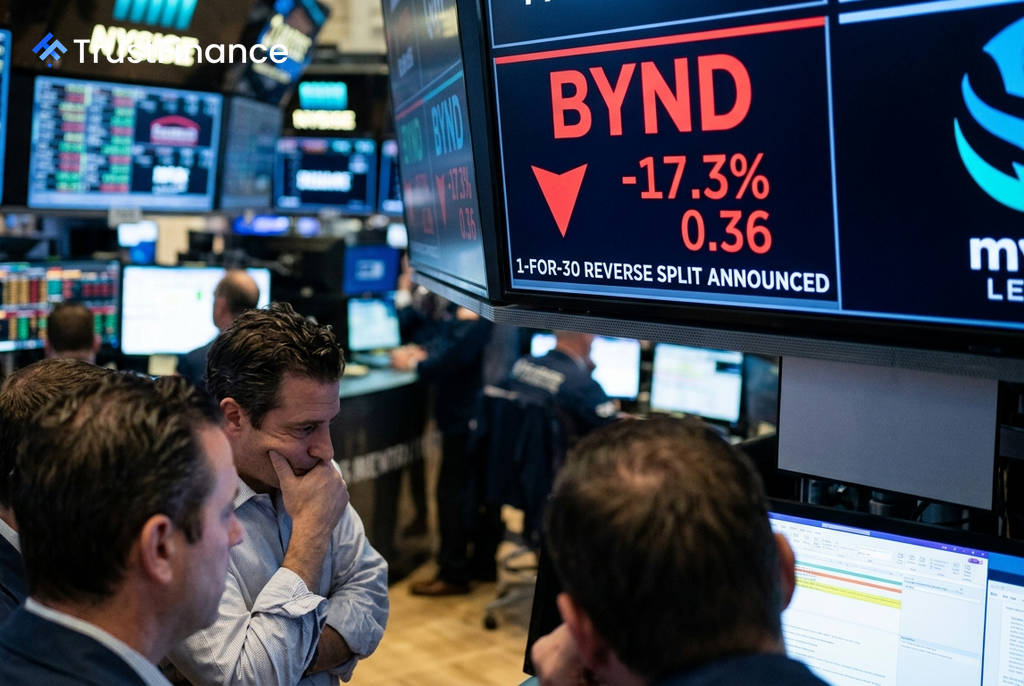
Beyond Meat (NASDAQ: BYND) shares plunged nearly 17% in pre-market trading on August 11 after the company announced a 1-for-30 reverse stock split. The move is a direct response to the risk of being delisted from the Nasdaq exchange due to its low share price.
Reverse Split to Avoid Delisting
Beyond Meat disclosed that the reverse stock split will take effect at 11:59 p.m. Eastern Time on August 13, 2026. The company's shares will begin trading on a split-adjusted basis the following day, August 14, under the existing "BYND" ticker.
The primary goal of the split, which consolidates every 30 existing shares into one new share, is to regain compliance with the Nasdaq Global Select Market's minimum bid price requirement. CEO Ethan Brown called the action "an important step toward maintaining our Nasdaq listing and better positioning our stock for long-term investor participation."
For investors, a reverse stock split is often interpreted as a sign of financial distress, as it does not change the fundamental value of the company but is instead a technical maneuver to inflate the stock price. This perception is a key driver behind the significant pre-market selloff.
Compounding Financial Pressures
The announcement follows a series of negative developments for the plant-based protein maker. On August 5, Beyond Meat reported disappointing second-quarter 2026 results, which included:
 Ad
- An adjusted loss of $0.09 per share, missing consensus estimates.
- An adjusted EBITDA loss of $27.7 million.
- An 8.2% year-over-year decline in revenue, driven by a 9.5% drop in sales volume.
Management also guided for a further revenue decline of 11% in the third quarter. A day before the stock split news, the company also amended the terms of its 2030 convertible notes, signaling ongoing complexities with its debt structure.
Market Reaction and Sector Headwinds
The sharp decline in Beyond Meat's stock occurred in isolation from broader market trends, with the S&P 500 and Nasdaq posting modest gains. This indicates the selloff is entirely driven by company-specific news.
The company and the broader plant-based food category continue to face significant demand challenges, particularly in U.S. retail and foodservice channels. With its stock trading near a 52-week low of $0.50, the latest news has further eroded investor confidence in the face of a deteriorating fundamental outlook.
Read next
More on Stocks
FTC Orders Walmart, Uber, Delta to Disclose Data on Personalized Pricing
The U.S. Federal Trade Commission is demanding nine major companies, including leading retail, travel, and gig economy firms, to provide information on how they use consumer data for setting individual prices and wages.

Google Launches Gemini 4 Carbon AI Model to Bolster Cybersecurity Capabilities
Alphabet's Google has unveiled Gemini 4 Carbon, its latest AI model specifically designed for advanced cybersecurity tasks like vulnerability detection and secure code generation. The launch escalates competition with rivals OpenAI and Anthropic in the enterprise AI market.

Oracle Shares Surge After Unveiling $225 Billion Revenue Target for 2030
Oracle stock rose sharply after the company presented a long-term financial outlook targeting at least $225 billion in annual revenue by fiscal 2030, driven by its expanding AI infrastructure business.

DOJ Scrutinizes Nvidia's $12.9B Hugging Face Deal Amid Broader Antitrust Probe, Sources Say
The U.S. Department of Justice is reportedly examining Nvidia's planned $12.93 billion acquisition of AI platform Hugging Face as part of a wider, ongoing antitrust investigation into the chipmaker's market conduct.