
Story
Beyond Leverage: How Options Trading Influences Broader Stock Market Dynamics
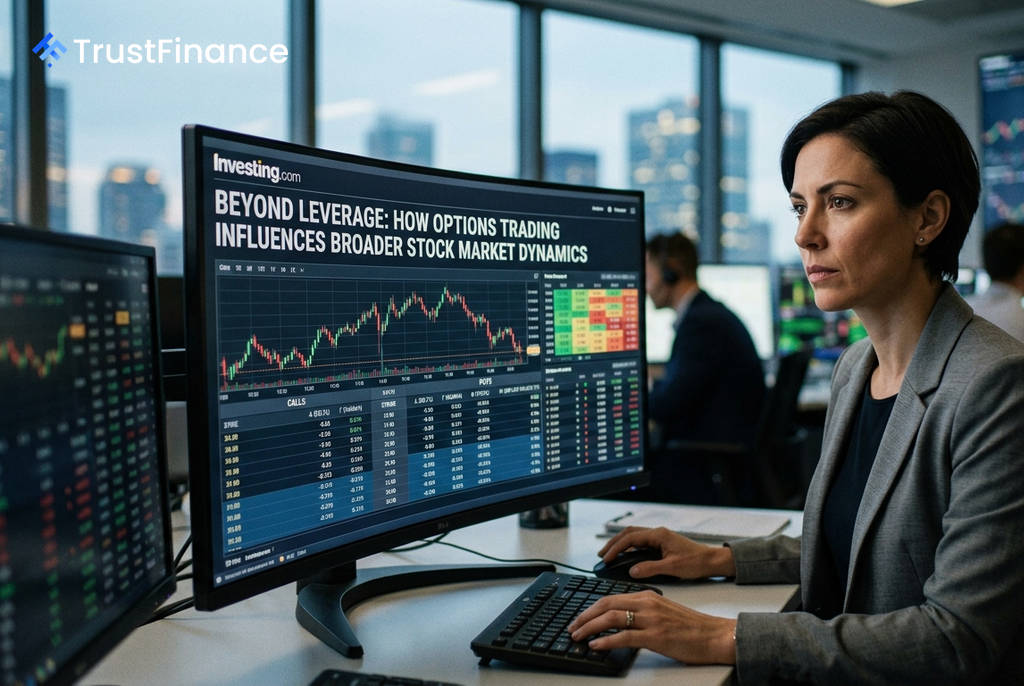
Options contracts do more than derive their value from an underlying asset; they can be a significant force in shaping market direction. The hedging activities required by large dealers and market makers can create powerful feedback loops that influence stock prices, a dynamic often overlooked by retail investors.
The Mechanics of an Option
An option is a contract giving the buyer the right, but not the obligation, to buy or sell an underlying asset at a predetermined price on or before a specific date. The core components are:
- Call Option: The right to buy an asset.
- Put Option: The right to sell an asset.
- Strike Price: The agreed-upon price for the transaction.
- Premium: The cost of purchasing the options contract.
For example, buying a call option with a $105 strike price on a stock currently trading at $100 might cost a $3 premium per share. Since one contract typically represents 100 shares, the total cost is $300. The buyer's maximum loss is limited to this premium, creating leverage. However, for the trade to be profitable at expiration, the stock must rise above the breakeven price of $108 (strike price plus premium).
How Options Move the Market
The most significant market impact comes from dealer hedging. When investors buy options, market makers typically take the other side of the trade. To manage their risk, these dealers hedge their positions by buying or selling the underlying stock.
 Ad
This activity can create a "gamma effect." As a stock's price rises toward the strike price of many call options, dealers who sold those calls must buy more of the underlying stock to hedge their exposure. This buying pressure can accelerate the rally. Conversely, as a stock falls, hedging against put options can force dealers to sell shares, potentially intensifying a decline. The pricing of options also reveals the market's expectation of future price swings, known as implied volatility.
Key Risks Beyond Price Direction
Profitability in options trading depends on more than just correctly predicting a stock's direction. Several factors can cause an option's value to decline, even if the underlying stock moves favorably.
Key risks for options traders include:
- Time Decay: As an option approaches its expiration date, its time value erodes, a process that accelerates in the final weeks and days. An option can expire worthless even if the stock moved in the right direction, but not quickly or far enough.
- Implied Volatility: A decrease in expected market volatility can lower an option's premium, causing losses for the option holder. This is often referred to as "vega risk."
- Leverage: While leverage can amplify gains, it equally magnifies losses. Common mistakes for beginners include buying cheap, far-out-of-the-money options that have a low probability of success or selling options without fully understanding the risk of substantial, and sometimes unlimited, losses.
Read next
More on Stocks
FTC Orders Walmart, Uber, Delta to Disclose Data on Personalized Pricing
The U.S. Federal Trade Commission is demanding nine major companies, including leading retail, travel, and gig economy firms, to provide information on how they use consumer data for setting individual prices and wages.

Google Launches Gemini 4 Carbon AI Model to Bolster Cybersecurity Capabilities
Alphabet's Google has unveiled Gemini 4 Carbon, its latest AI model specifically designed for advanced cybersecurity tasks like vulnerability detection and secure code generation. The launch escalates competition with rivals OpenAI and Anthropic in the enterprise AI market.

Oracle Shares Surge After Unveiling $225 Billion Revenue Target for 2030
Oracle stock rose sharply after the company presented a long-term financial outlook targeting at least $225 billion in annual revenue by fiscal 2030, driven by its expanding AI infrastructure business.

DOJ Scrutinizes Nvidia's $12.9B Hugging Face Deal Amid Broader Antitrust Probe, Sources Say
The U.S. Department of Justice is reportedly examining Nvidia's planned $12.93 billion acquisition of AI platform Hugging Face as part of a wider, ongoing antitrust investigation into the chipmaker's market conduct.