
Story
Baidu Shares Tumble as 19% Advertising Decline Overshadows AI Growth
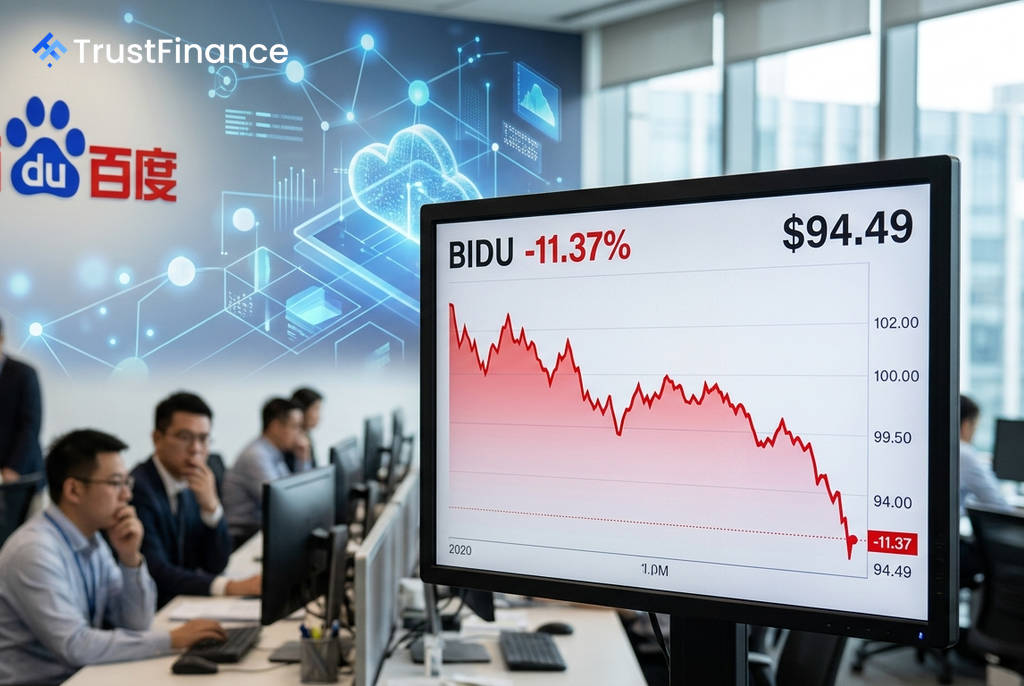
Baidu Inc. (NASDAQ: BIDU) shares fell more than 9% after the company reported second-quarter 2026 earnings that missed Wall Street estimates, as a persistent and steep decline in its legacy advertising business overshadowed significant growth in its artificial intelligence units.
Earnings Miss and Market Reaction
The Chinese technology giant announced revenue of CNY 31.3 billion, falling short of the consensus estimate of CNY 31.95 billion. Earnings per share (EPS) came in at CNY 7.22, a 26.6% miss compared to the expected CNY 9.84.
Following the release, Baidu's U.S.-listed shares dropped 9.25% to trade at $94.49, according to the source. The report highlighted the central challenge for investors: a race between the company's declining traditional revenue streams and its emerging growth engines.
A Tale of Two Businesses
The quarter's results presented a stark contrast between Baidu's core business and its AI-focused future.
AI Provides a Bright Spot
Baidu's AI-powered business lines demonstrated robust growth, reaching CNY 12.5 billion in revenue for the quarter. This now accounts for 50% of the company's general business revenue, up from 43% in the prior quarter. Key growth drivers included:
- GPU cloud infrastructure, which saw revenue surge 283% year-over-year.
- Overall AI Cloud Infrastructure, which grew 50% year-over-year to CNY 7.3 billion.
 Ad
Advertising in Structural Decline
Conversely, core advertising revenue plummeted 19% year-over-year to CNY 13.1 billion, marking the fourth consecutive quarter of declines between 15% and 21%. Management attributed the weakness to a structural shift as users migrate from traditional search to AI chatbots and e-commerce platforms alter their ad spending. The company explicitly warned that its online marketing segment will remain under pressure through the second half of 2026.
Margin Pressure and Outlook
The divergence between the two segments, combined with other financial factors, squeezed the company's profitability. The GAAP operating margin compressed to 10%, while net margin fell to 7%. This was exacerbated by a sharp drop in other income, which fell to CNY 184 million from CNY 4.9 billion a year earlier due to smaller fair-value gains and foreign exchange losses.
Looking ahead, Baidu's management indicated that planned increases in AI-related capital expenditures in the second half of the year will continue to weigh on operating expenses. Analysts are taking note, with Bank of America cutting its price target on the stock to $165 from $180, as cited in the source material.
Catalysts on the Horizon
Investors will be watching several key developments in the coming months. These include a shareholder vote on August 26 to convert its Hong Kong listing to a dual primary one, which could expand its investor base. Other potential catalysts are the planned spin-off and IPO of its Kunlun AI chip unit and progress updates on the international expansion of its Apollo Go autonomous ride-hailing service.
Read next
More on Stocks
FTC Orders Walmart, Uber, Delta to Disclose Data on Personalized Pricing
The U.S. Federal Trade Commission is demanding nine major companies, including leading retail, travel, and gig economy firms, to provide information on how they use consumer data for setting individual prices and wages.

Google Launches Gemini 4 Carbon AI Model to Bolster Cybersecurity Capabilities
Alphabet's Google has unveiled Gemini 4 Carbon, its latest AI model specifically designed for advanced cybersecurity tasks like vulnerability detection and secure code generation. The launch escalates competition with rivals OpenAI and Anthropic in the enterprise AI market.

Oracle Shares Surge After Unveiling $225 Billion Revenue Target for 2030
Oracle stock rose sharply after the company presented a long-term financial outlook targeting at least $225 billion in annual revenue by fiscal 2030, driven by its expanding AI infrastructure business.

DOJ Scrutinizes Nvidia's $12.9B Hugging Face Deal Amid Broader Antitrust Probe, Sources Say
The U.S. Department of Justice is reportedly examining Nvidia's planned $12.93 billion acquisition of AI platform Hugging Face as part of a wider, ongoing antitrust investigation into the chipmaker's market conduct.