
Story
Baidu Shares Fall to Near 1-Year Low as Ad Weakness Outweighs AI Growth
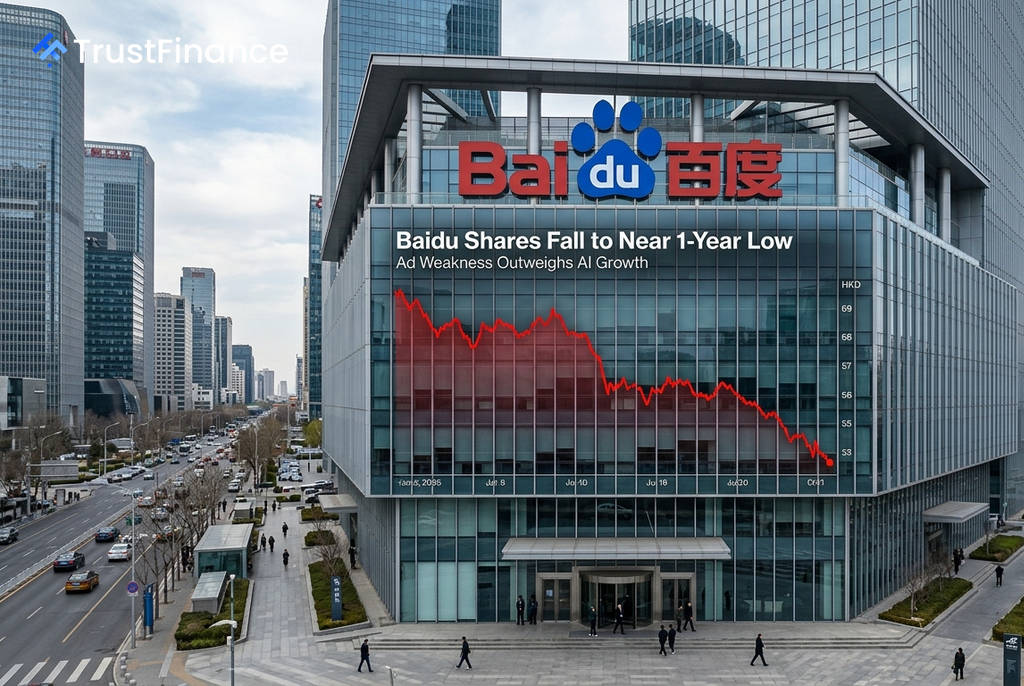
Baidu Inc. shares plummeted 13% in Hong Kong trading on Wednesday, hitting a near one-year low after the Chinese technology company reported second-quarter financial results that fell short of market expectations. The sell-off highlights investor concerns that strong growth in Baidu's artificial intelligence businesses is not yet sufficient to offset the persistent decline in its core online marketing services.
Earnings Miss Across the Board
Baidu's stock fell to HK$87.95, its lowest point in nearly a year, significantly underperforming the broader Hang Seng Index. The drop was a direct reaction to the company's Q2 earnings release, which revealed misses on key metrics compared to consensus estimates compiled by Visible Alpha.
- Total Revenue: Reported at CNY31.33 billion, below the consensus estimate of CNY31.95 billion.
- Non-GAAP Net Income: Came in at CNY2.6 billion, approximately 16% lower than the expected CNY3.1 billion.
- Non-GAAP Diluted EPS: Stood at CNY7.22 per ADS, a sharp decrease from CNY12.06 a year earlier and well below the CNY9.84 consensus.
A Business in Transition
The earnings report illustrates the challenge Baidu faces in its strategic pivot from a search and internet company to an AI-focused enterprise. Revenue from its legacy online marketing services, long the company's primary profit engine, fell 19% year-over-year to CNY13.1 billion amid weaker advertising demand.
 Ad
In contrast, Baidu Core’s AI-powered business segment generated CNY12.5 billion, a 25% increase from the prior year. This segment, which now accounts for half of the General Business revenue, saw exceptional performance in specific areas, with AI Cloud Infrastructure revenue jumping 50% and GPU Cloud revenue surging 283%.
Profitability and Outlook
Despite the impressive growth rates in AI, the segment has not yet grown large enough to compensate for the revenue erosion in the advertising division, leading to a 4% decline in total Baidu General Business revenue. The sharp deterioration in overall profitability has put Baidu's heavy investments in AI under greater scrutiny.
For investors, the central question is whether Baidu can successfully monetize its AI infrastructure and applications at a scale that can replace lost advertising profits. The company continues to navigate this transition while facing intense competition in China's domestic AI market.
Read next
More on Stocks
FTC Orders Walmart, Uber, Delta to Disclose Data on Personalized Pricing
The U.S. Federal Trade Commission is demanding nine major companies, including leading retail, travel, and gig economy firms, to provide information on how they use consumer data for setting individual prices and wages.

Google Launches Gemini 4 Carbon AI Model to Bolster Cybersecurity Capabilities
Alphabet's Google has unveiled Gemini 4 Carbon, its latest AI model specifically designed for advanced cybersecurity tasks like vulnerability detection and secure code generation. The launch escalates competition with rivals OpenAI and Anthropic in the enterprise AI market.

Oracle Shares Surge After Unveiling $225 Billion Revenue Target for 2030
Oracle stock rose sharply after the company presented a long-term financial outlook targeting at least $225 billion in annual revenue by fiscal 2030, driven by its expanding AI infrastructure business.

DOJ Scrutinizes Nvidia's $12.9B Hugging Face Deal Amid Broader Antitrust Probe, Sources Say
The U.S. Department of Justice is reportedly examining Nvidia's planned $12.93 billion acquisition of AI platform Hugging Face as part of a wider, ongoing antitrust investigation into the chipmaker's market conduct.