
Story
Australian Financials in Focus as Strong GDP Data Boosts RBA Rate Hike Odds
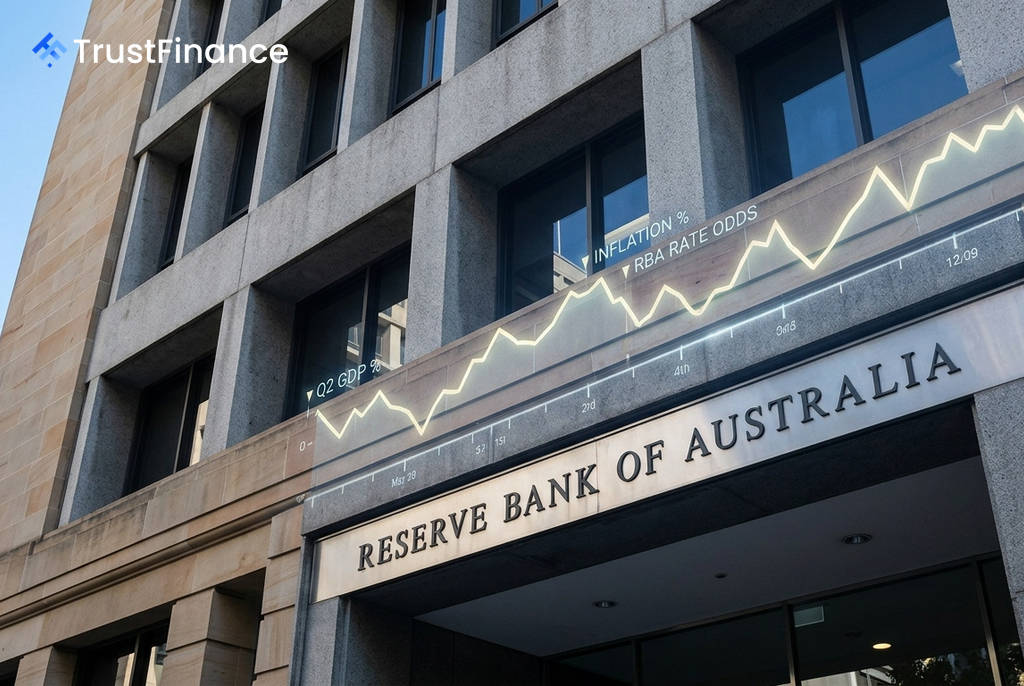
Market expectations for another interest rate hike by the Reserve Bank of Australia (RBA) are growing after recent economic data surpassed forecasts. This has placed a spotlight on financial sector companies that are often positioned to benefit from higher borrowing costs.
Economic Data Fuels Hawkish Bets
Australia’s second-quarter Gross Domestic Product (GDP) grew by 0.4%, beating consensus forecasts of 0.3%, according to a report from Investing.com. On an annual basis, the economy expanded 2.1%, which was stronger than the 1.8% that had been anticipated.
This resilient growth data could keep inflation concerns at the forefront for the RBA, potentially supporting a more hawkish monetary policy stance in the coming months. However, the report also noted that weaker domestic demand means that risks of an economic slowdown or recession remain a critical counterweight to the inflation narrative.
Financial Sector Sensitivity to Rates
Higher interest rates, while often a headwind for the broader stock market, can provide a tailwind for certain financial firms. Banks may benefit from an expansion in net interest margins if they can increase lending rates faster than their funding costs on deposits.
 Ad
Insurers can also see improved profitability as they reinvest their large fixed-income portfolios at higher yields, boosting their investment income over time. Both sectors, however, face risks if sharply higher rates weaken borrowers and lead to a rise in credit losses or reduce the value of their existing assets.
Key Stocks and Valuations
An analysis highlighted several Australian financial stocks that could be sensitive to a rising rate environment, based on a combination of valuation and business model characteristics.
- Westpac Banking Corp. (WBC): Noted for its valuation, with a price-to-earnings (P/E) ratio of 17.0x, the lowest among the major banks screened.
- QBE Insurance Group (QBE): Cited for its strong profile, combining a 19.2% return on equity (ROE) with a relatively low P/E ratio of 11.4x.
- ANZ Holdings (ANZ): Recognized for its strong recent share price momentum compared to its peers.
- Challenger (CGF): Identified as a more direct beneficiary of higher long-term yields due to its annuity and retirement income business.
In contrast, the analysis pointed out that a market leader like Commonwealth Bank of Australia (CBA) trades at a premium valuation with a P/E ratio of 24.3x, suggesting that much of the potential upside from rate hikes may already be reflected in its stock price.
Read next
More on Stocks
FTC Orders Walmart, Uber, Delta to Disclose Data on Personalized Pricing
The U.S. Federal Trade Commission is demanding nine major companies, including leading retail, travel, and gig economy firms, to provide information on how they use consumer data for setting individual prices and wages.

Google Launches Gemini 4 Carbon AI Model to Bolster Cybersecurity Capabilities
Alphabet's Google has unveiled Gemini 4 Carbon, its latest AI model specifically designed for advanced cybersecurity tasks like vulnerability detection and secure code generation. The launch escalates competition with rivals OpenAI and Anthropic in the enterprise AI market.

Oracle Shares Surge After Unveiling $225 Billion Revenue Target for 2030
Oracle stock rose sharply after the company presented a long-term financial outlook targeting at least $225 billion in annual revenue by fiscal 2030, driven by its expanding AI infrastructure business.

DOJ Scrutinizes Nvidia's $12.9B Hugging Face Deal Amid Broader Antitrust Probe, Sources Say
The U.S. Department of Justice is reportedly examining Nvidia's planned $12.93 billion acquisition of AI platform Hugging Face as part of a wider, ongoing antitrust investigation into the chipmaker's market conduct.