
Story
AstraZeneca's Tezspire Succeeds in Late-Stage Esophagus Disease Trial
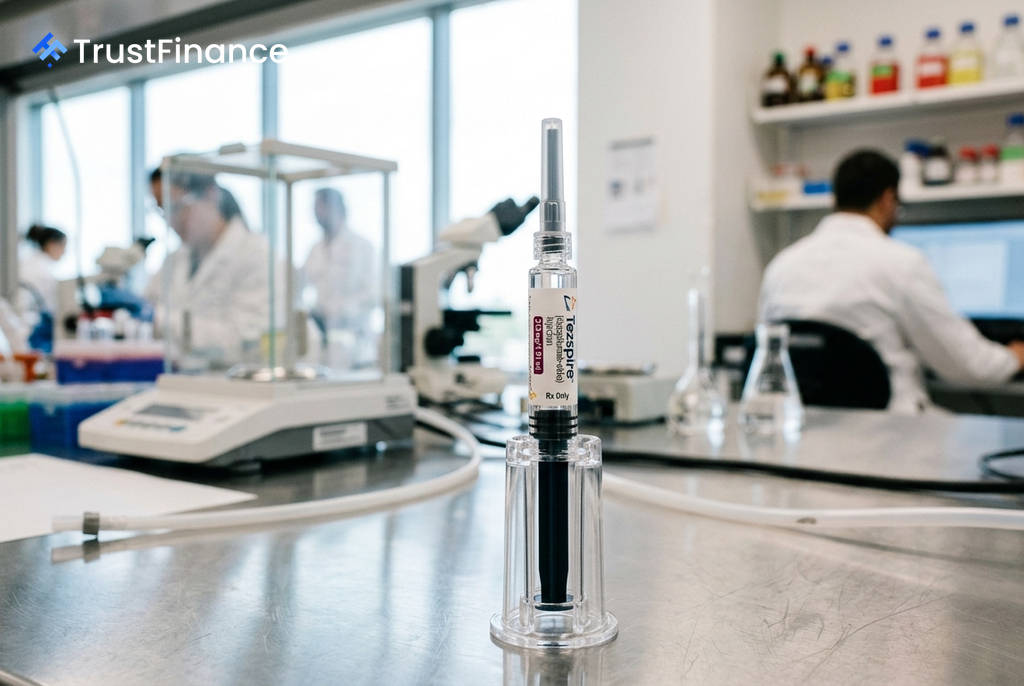
AstraZeneca announced Thursday that its drug Tezspire, developed in partnership with Amgen, met its primary goals in a late-stage trial for a chronic inflammatory disorder of the esophagus. The positive results offer a needed boost to the pharmaceutical giant's pipeline following several recent clinical setbacks.
Trial Success and Potential Expansion
The trial evaluated Tezspire in patients with eosinophilic esophagitis (EoE), a condition affecting more than 470,000 people in the United States. According to the company's statement, the drug significantly reduced inflammation in the esophagus and eased difficulty in swallowing when compared to a placebo.
Tezspire is a monoclonal antibody that works by blocking TSLP, a protein that can trigger inflammation. The drug is already approved in the U.S. and other markets as an add-on treatment for severe asthma, where it competes with Sanofi and Regeneron's Dupixent. The drug generated $1.13 billion in sales for AstraZeneca in 2025.
Context of Recent Setbacks
The successful trial provides a welcome win for AstraZeneca, which has faced a string of disappointing clinical and regulatory outcomes recently. These challenges are a headwind to CEO Pascal Soriot's goal of reaching $80 billion in annual sales by 2030.
 Ad
Recent setbacks for the company's pipeline include:
- Wainua: Unexpectedly failed a heart disease trial in July.
- Ultomiris: A late-stage study for a rare disease failed to meet its goals.
- Camizestrant: A U.S. regulatory panel rejected the breast cancer drug in May due to trial design concerns.
- Volrustomig: An advanced study for this experimental lung cancer drug was halted this month.
Market Impact and Outlook
Despite the positive news, AstraZeneca’s shares were down 0.5% in early trading Thursday, according to Reuters. The stock has fallen 14% since the Wainua trial failure was announced in July.
Analysts note that investor focus remains fixed on upcoming results from two major cancer trials, which are viewed as more critical to the company's near-term growth prospects and share price performance. The Tezspire results, while encouraging for expanding the drug's label, have not yet shifted the broader market sentiment.
Read next
More on Stocks
FTC Orders Walmart, Uber, Delta to Disclose Data on Personalized Pricing
The U.S. Federal Trade Commission is demanding nine major companies, including leading retail, travel, and gig economy firms, to provide information on how they use consumer data for setting individual prices and wages.

Google Launches Gemini 4 Carbon AI Model to Bolster Cybersecurity Capabilities
Alphabet's Google has unveiled Gemini 4 Carbon, its latest AI model specifically designed for advanced cybersecurity tasks like vulnerability detection and secure code generation. The launch escalates competition with rivals OpenAI and Anthropic in the enterprise AI market.

Oracle Shares Surge After Unveiling $225 Billion Revenue Target for 2030
Oracle stock rose sharply after the company presented a long-term financial outlook targeting at least $225 billion in annual revenue by fiscal 2030, driven by its expanding AI infrastructure business.

DOJ Scrutinizes Nvidia's $12.9B Hugging Face Deal Amid Broader Antitrust Probe, Sources Say
The U.S. Department of Justice is reportedly examining Nvidia's planned $12.93 billion acquisition of AI platform Hugging Face as part of a wider, ongoing antitrust investigation into the chipmaker's market conduct.