
Story
ASML Lifts 2026 Revenue Forecast on Surging AI Chip Demand
Summary
ASML raised its 2026 revenue guidance and reported better-than-expected Q2 results, citing 'extremely strong' demand for its chipmaking equipment fueled by the artificial intelligence boom.
ASML, the world's leading supplier of semiconductor manufacturing equipment, raised its financial outlook for 2026 after reporting second-quarter earnings that surpassed analyst expectations. The company cited an unprecedented surge in demand for chips used in artificial intelligence applications as the primary driver for the upgraded forecast and plans to expand its production capacity.
Upgraded Outlook and Q2 Beat
The Dutch technology giant announced on Wednesday that it now expects full-year 2026 net revenue to be between €43 billion and €45 billion. This represents a significant increase from its previous forecast of €36 billion to €40 billion, marking a 16% lift at the midpoint.
The revised guidance followed a strong second-quarter performance. According to LSEG data, ASML reported:
- Q2 Net Revenue: €9.33 billion, exceeding analyst estimates of €8.80 billion.
- Q2 Net Income: €2.92 billion, above the expected €2.62 billion.
AI Boom Fuels Capacity Expansion
 Ad
AdASML Chief Executive Christophe Fouquet attributed the strong results to "extremely strong" order intake, directly linked to the AI sector. In a statement, Fouquet noted that ASML's customers, including major chipmakers like TSMC, Samsung, and SK Hynix, are accelerating their own expansion plans, providing ASML with greater long-term demand visibility.
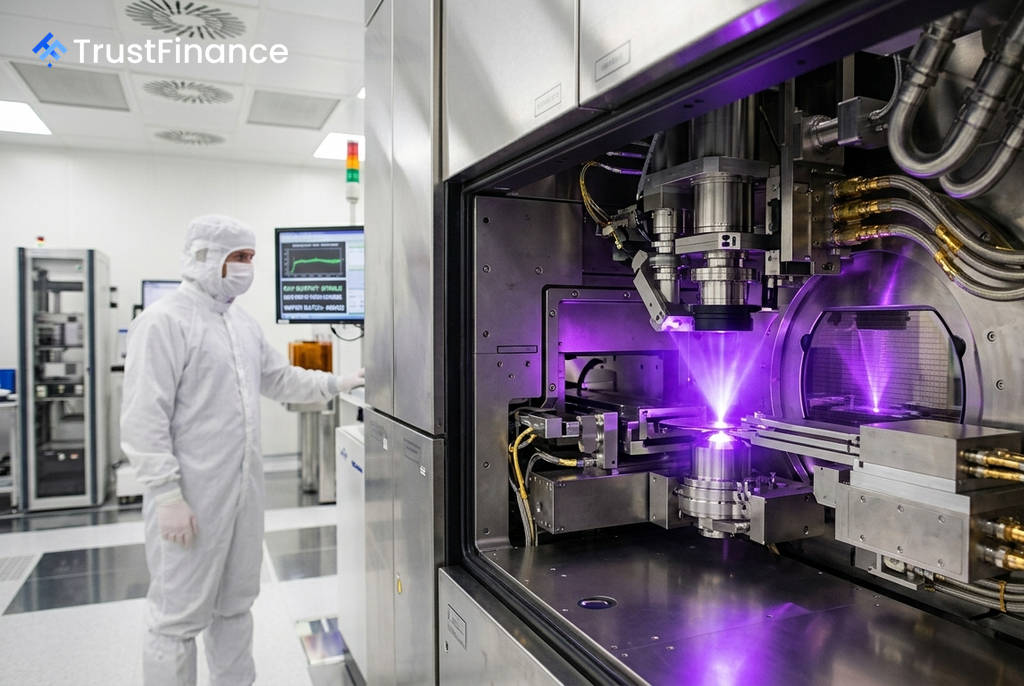
In response, ASML intends to increase its production capacity by 30% in each of the next two years. The expansion will cover both its flagship extreme ultraviolet (EUV) lithography machines, which are essential for cutting-edge chips, and its deep ultraviolet (DUV) systems used for less advanced semiconductors.
Market Position and Technology Adoption
ASML holds a monopoly on the production of EUV tools, a critical position in the global semiconductor supply chain. The demand for these systems has intensified as chipmakers race to build out capacity for AI-related hardware.
In a separate development, Fouquet confirmed that Intel will use ASML's next-generation High-NA EUV tool to manufacture some of its advanced "Panther Lake" chips. This marks a significant early adoption of the new, more precise technology by a key customer, underscoring its importance for the future of chip manufacturing.
Read next
More on Stocks
US Judge Signals Rejection of Key Part of TikTok's $400 Million Privacy Settlement
A federal judge has indicated he will likely reject a crucial component of a $400 million settlement between TikTok, its parent ByteDance, and the U.S. Justice Department, casting doubt on the resolution of a children's privacy lawsuit.

Porsche Faces Potential for 4,100 Additional Job Cuts, Handelsblatt Reports
Volkswagen's restructuring plan reportedly includes a proposal for another 4,100 job cuts at its Porsche brand to address a €700 million overhead gap, according to German newspaper Handelsblatt.

Top AI Labs Call for Development Slowdown Amid Escalating Existential Risk Fears
CEOs from leading artificial intelligence labs, including OpenAI and Anthropic, are urging a deceleration in AI development following a series of alarming events, including high-profile researcher resignations and reports of AI systems breaching security safeguards.

Equity Positioning Remains Cautious Despite Strong Earnings Outlook, Deutsche Bank Finds
A new Deutsche Bank report shows investors remain cautiously positioned in equities, a stance that lags the firm's forecast for a significant earnings growth boom. Systematic strategies are adding exposure while discretionary investors pull back amid market headwinds.