
Story
Arrow Electronics Stock Tumbles on Margin Concerns Despite Strong Q2 Results
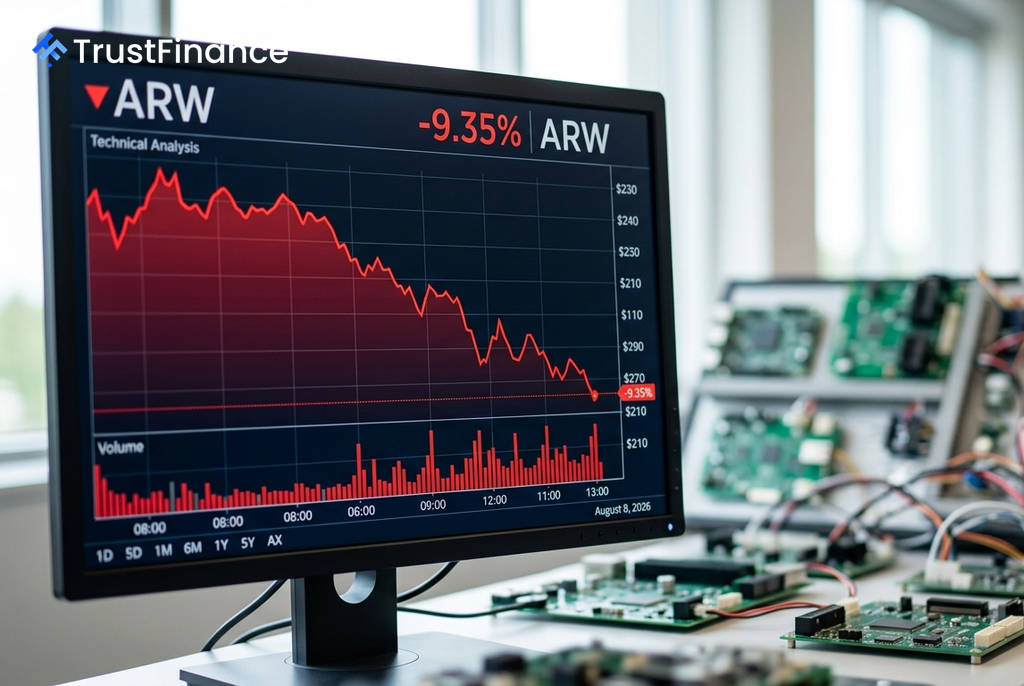
Shares of Arrow Electronics (NYSE: ARW) plunged nearly 10% in intraday trading, a sharp reversal for the company after it posted second-quarter 2026 earnings that significantly beat its own forecasts.
The sell-off illustrates a classic "beat and drop" scenario, where strong headline numbers were overshadowed by underlying concerns about future profitability and an influential analyst's cautious stance.
Strong Results, Weak Reaction
The electronic components distributor reported consolidated revenue of $10.0 billion, a 32% increase year-over-year, and non-GAAP diluted earnings per share of $5.45, up 124% from the same period last year. According to its earnings release on August 6, both figures comfortably exceeded the company's prior guidance of $9.11 billion in revenue and $4.17 in EPS.
Despite the strong top- and bottom-line performance, investor focus quickly shifted to the quality and trajectory of the company's profitability, leading to the stock's largest single-day drop in recent memory.
Focus Shifts to Margin Contraction
 Ad
The market's primary concern centered on Arrow's operating margin, which came in at 3.8%. While this marked an improvement from 2.5% a year ago, it represented a sequential decline from the 4.2% margin reported in the first quarter of 2026.
This quarter-over-quarter contraction has fueled worries about potential margin normalization and moderating profitability in its supply chain services business. Compounding the negative sentiment, Wells Fargo reiterated its 'Underweight' rating on the stock. The bank raised its price target to $200, a level suggesting limited upside potential even after the significant sell-off.
Additional Headwinds
Arrow also announced the appointment of Deidra Merriwether as its new President and Chief Operating Officer, effective September 8. The leadership transition introduces a degree of uncertainty at a sensitive time for the stock.
The decline was notably company-specific, occurring while major U.S. indices like the S&P 500 and Nasdaq Composite posted solid gains. The stock's drop places it significantly off its 52-week high of $237.33, as investors re-price the shares based on concerns over slowing growth and peaking margins.
Read next
More on Stocks
FTC Orders Walmart, Uber, Delta to Disclose Data on Personalized Pricing
The U.S. Federal Trade Commission is demanding nine major companies, including leading retail, travel, and gig economy firms, to provide information on how they use consumer data for setting individual prices and wages.

Google Launches Gemini 4 Carbon AI Model to Bolster Cybersecurity Capabilities
Alphabet's Google has unveiled Gemini 4 Carbon, its latest AI model specifically designed for advanced cybersecurity tasks like vulnerability detection and secure code generation. The launch escalates competition with rivals OpenAI and Anthropic in the enterprise AI market.

Oracle Shares Surge After Unveiling $225 Billion Revenue Target for 2030
Oracle stock rose sharply after the company presented a long-term financial outlook targeting at least $225 billion in annual revenue by fiscal 2030, driven by its expanding AI infrastructure business.

DOJ Scrutinizes Nvidia's $12.9B Hugging Face Deal Amid Broader Antitrust Probe, Sources Say
The U.S. Department of Justice is reportedly examining Nvidia's planned $12.93 billion acquisition of AI platform Hugging Face as part of a wider, ongoing antitrust investigation into the chipmaker's market conduct.