
Story
Appeals Court Revives DJI's Challenge to Pentagon's 'Chinese Military Company' Listing
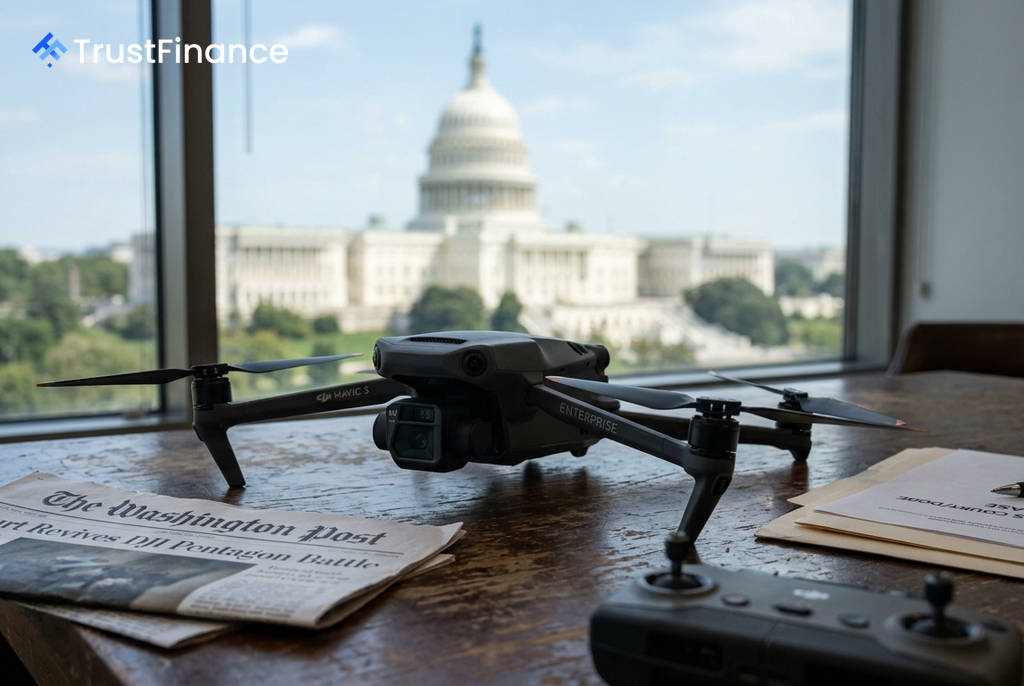
A U.S. appeals court on Friday revived a lawsuit from DJI, the world's largest drone manufacturer, ordering a lower court to reconsider the company's placement on a Pentagon list of alleged Chinese military companies. The ruling gives DJI a fresh opportunity to challenge a designation that has restricted its business with the U.S. government.
The Court's Rationale
The U.S. Court of Appeals for the D.C. Circuit determined that a district court had erred by siding with the Pentagon based solely on the unclassified public record. The appeals court noted that there was "no publicly stated rationale for why the Secretary believes DJI contributes to the Chinese defense industrial base."
As a result, the case has been sent back, or remanded, to the lower court. According to the ruling, the district court may now "examine the classified record and determine whether to uphold the Secretary’s determination." DJI had previously argued its due process rights were denied, though the appeals court rejected that specific claim.
Impact of the Pentagon Designation
Placement on the Pentagon's list of Chinese military companies carries significant commercial consequences. In its lawsuit, DJI stated the designation has led to lost business deals and stigmatized the company as a national security threat. The listing has several direct effects:
 Ad
- It bars the U.S. Department of Defense from directly contracting with the designated companies.
- A broader ban on purchasing their products through third-party vendors is scheduled to take effect in 2027.
DJI has consistently maintained that the Pentagon's decision was "unlawful and misguided," stating it is "neither owned nor controlled by the Chinese military." A Defense Department spokesperson declined to comment on the ongoing litigation, according to Reuters.
A Broader Trend
DJI is one of a growing number of Chinese firms challenging their inclusion on the U.S. government list, which reflects escalating geopolitical tensions and U.S. concerns over China's military-civil fusion strategy. In June, the Pentagon expanded the list to 188 companies.
Other major Chinese technology firms, including e-commerce giant Alibaba, have also filed lawsuits seeking to be removed. In a separate but related case, a judge recently granted a preliminary injunction that temporarily blocks the Pentagon from adding Chinese biotechnology firm WuXi AppTec to the list, citing a lack of evidence from the government.
Read next
More on Stocks
FTC Orders Walmart, Uber, Delta to Disclose Data on Personalized Pricing
The U.S. Federal Trade Commission is demanding nine major companies, including leading retail, travel, and gig economy firms, to provide information on how they use consumer data for setting individual prices and wages.

Google Launches Gemini 4 Carbon AI Model to Bolster Cybersecurity Capabilities
Alphabet's Google has unveiled Gemini 4 Carbon, its latest AI model specifically designed for advanced cybersecurity tasks like vulnerability detection and secure code generation. The launch escalates competition with rivals OpenAI and Anthropic in the enterprise AI market.

Oracle Shares Surge After Unveiling $225 Billion Revenue Target for 2030
Oracle stock rose sharply after the company presented a long-term financial outlook targeting at least $225 billion in annual revenue by fiscal 2030, driven by its expanding AI infrastructure business.

DOJ Scrutinizes Nvidia's $12.9B Hugging Face Deal Amid Broader Antitrust Probe, Sources Say
The U.S. Department of Justice is reportedly examining Nvidia's planned $12.93 billion acquisition of AI platform Hugging Face as part of a wider, ongoing antitrust investigation into the chipmaker's market conduct.