
Story
Analysis: Which Apple Suppliers Are Most Exposed to an iPhone Slowdown?
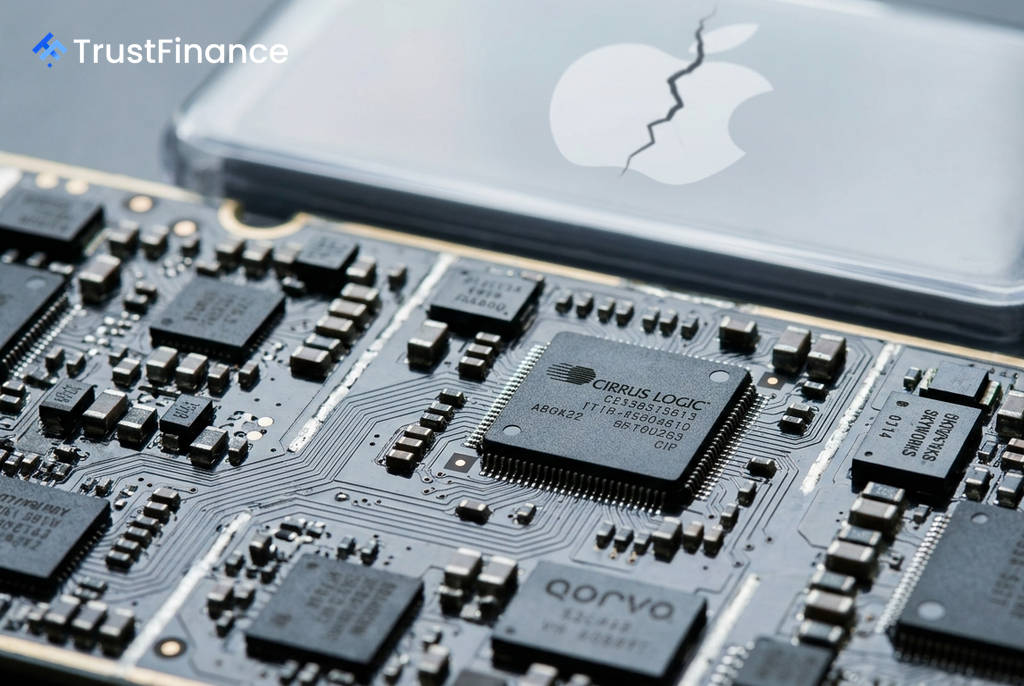
Growing market caution over a potential slowdown in iPhone sales is highlighting a stark divergence within Apple Inc.'s global supply chain. An analysis by Investing.com reveals that suppliers with heavy revenue concentration from the tech giant face significant risk, while more diversified partners are better positioned to weather any weakness in smartphone demand.
The Concentration Risk
The primary vulnerability for many component makers is their high dependence on Apple for a large portion of their total sales. According to data from Investing.com, the exposure levels vary dramatically across key suppliers:
- Cirrus Logic (CRUS): Leads with an estimated 70-80% of its revenue tied to Apple, placing it in the most vulnerable position.
- Skyworks Solutions (SWKS): Relies on Apple for approximately 50-60% of its revenue.
- Qorvo (QRVO): Has a revenue exposure of around 40-50%.
- Taiwan Semiconductor (TSM): A more moderate 25% of revenue comes from Apple.
- Broadcom (AVGO): Has a relatively low exposure at 15-20%.
This high concentration means that even a modest decline in iPhone production could translate into a significant revenue drop for the most dependent companies.
Early Signs of Weakness
 Ad
For some suppliers, the impact of a softening market may already be materializing. The Investing.com analysis notes that Skyworks Solutions has seen its revenue decline over the past three years, and its net margins are a razor-thin 7.2%, offering little buffer against volume decreases.
Similarly, Qorvo has experienced flat to slightly negative revenue growth. Universal Display (OLED), which also has a 40-50% exposure to Apple, has seen its stock fall 37.2% over the past year, suggesting investors are pricing in future weakness. Cirrus Logic's stock has also dropped 16.9% over the last six months, reflecting its extreme sensitivity to iPhone build rates.
The Diversification Shield
In contrast, some of Apple's largest suppliers appear well-insulated from a potential iPhone downturn, primarily due to their diversification into high-growth sectors like artificial intelligence. Taiwan Semiconductor, the world's largest contract chipmaker, is reporting revenue growth of 30.6% with an exceptional 49.9% net margin, largely driven by soaring demand for AI chips.
Likewise, Broadcom is posting strong revenue growth of 32.3%, fueled by its business in custom AI accelerators and its recent integration of VMware. For these diversified technology leaders, softness in the smartphone market is more easily offset by strength in other segments, providing a crucial buffer that their more specialized peers lack.
Read next
More on Stocks
FTC Orders Walmart, Uber, Delta to Disclose Data on Personalized Pricing
The U.S. Federal Trade Commission is demanding nine major companies, including leading retail, travel, and gig economy firms, to provide information on how they use consumer data for setting individual prices and wages.

Google Launches Gemini 4 Carbon AI Model to Bolster Cybersecurity Capabilities
Alphabet's Google has unveiled Gemini 4 Carbon, its latest AI model specifically designed for advanced cybersecurity tasks like vulnerability detection and secure code generation. The launch escalates competition with rivals OpenAI and Anthropic in the enterprise AI market.

Oracle Shares Surge After Unveiling $225 Billion Revenue Target for 2030
Oracle stock rose sharply after the company presented a long-term financial outlook targeting at least $225 billion in annual revenue by fiscal 2030, driven by its expanding AI infrastructure business.

DOJ Scrutinizes Nvidia's $12.9B Hugging Face Deal Amid Broader Antitrust Probe, Sources Say
The U.S. Department of Justice is reportedly examining Nvidia's planned $12.93 billion acquisition of AI platform Hugging Face as part of a wider, ongoing antitrust investigation into the chipmaker's market conduct.