
Story
Analysis: Japan's Heavy Industrials Offer Diverse Exposure to Growing Space Sector
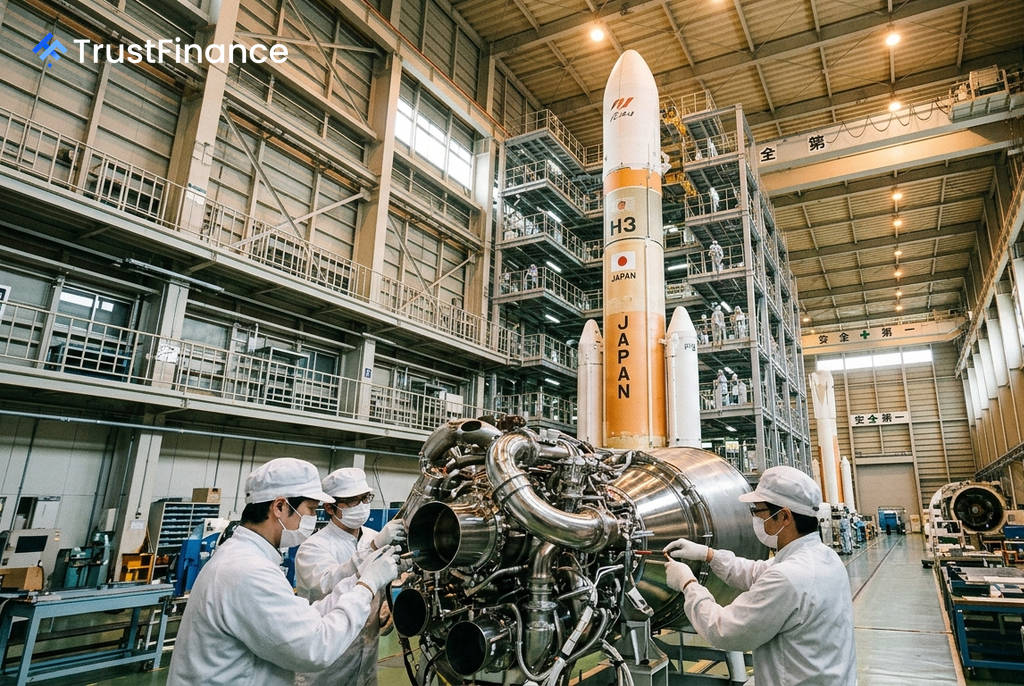
Japan's three largest heavy industrial firms—IHI Corp, Mitsubishi Heavy Industries, and Kawasaki Heavy Industries—are the central pillars of the nation's burgeoning space and rocket programs. According to an analysis of the sector, these companies form a tightly integrated ecosystem, each offering investors a different profile for exposure to a market bolstered by rising defense budgets.
The Industrial Triumvirate
Unlike a single-stock play, Japan's space ambitions are executed by a trio of established engineering giants. Mitsubishi Heavy Industries (7011) serves as the prime contractor, analogous to U.S. defense majors, responsible for the assembly of the complete H3 launch vehicle.
IHI Corp (7013) functions as the specialist in propulsion, manufacturing the critical solid and liquid fuel rocket engines for the Japan Aerospace Exploration Agency (JAXA). Kawasaki Heavy Industries (7012) contributes with its aerospace systems division, which covers aircraft structures and space exploitation systems, while maintaining a highly diversified business model.
Contrasting Financial Profiles
Each company presents a unique combination of valuation, growth, and risk, based on financial data from mid-August 2026.
 Ad
- IHI Corp (7013): Positioned as a pure-play on rocket propulsion, IHI trades at a forward price-to-earnings (P/E) ratio of 9.8x. The company reported strong earnings per share (EPS) growth of 91.8% and a return on equity (ROE) of 34.2%. However, analysts note its negative free cash flow and a relatively high debt-to-equity ratio of 69.9% as key risks.
- Mitsubishi Heavy Industries (7011): As the largest of the group with a ¥13.76 trillion market capitalization, MHI is the primary beneficiary of increased defense spending. It offers the strongest free cash flow yield at 7.0% and low market volatility with a beta of 0.37. This stability comes at a premium valuation, with a forward P/E of 31.3x and nearly flat revenue growth of 0.5%.
- Kawasaki Heavy Industries (7012): This firm stands out as an income-oriented option, providing the highest dividend yield of the trio at 4.2%. It also posted the fastest recent revenue growth at 8.9%. Investors should note its high leverage, with a debt-to-equity ratio of 100.4%, the highest in the group.
Geopolitical and Economic Context
The strategic push into space and defense is underpinned by Japan's response to rising regional security tensions. This has led to a structural increase in government spending on indigenous launch capabilities and satellite defense systems, creating a significant tailwind for all three companies.
However, the macroeconomic environment presents challenges. While a weak yen can boost export competitiveness, it also contributes to higher imported material and energy costs. Japan's producer price index (PPI) inflation, which stood at 7.2% in July 2026, is a key factor compressing margins across the heavy industry sector.
Read next
More on Stocks
FTC Orders Walmart, Uber, Delta to Disclose Data on Personalized Pricing
The U.S. Federal Trade Commission is demanding nine major companies, including leading retail, travel, and gig economy firms, to provide information on how they use consumer data for setting individual prices and wages.

Google Launches Gemini 4 Carbon AI Model to Bolster Cybersecurity Capabilities
Alphabet's Google has unveiled Gemini 4 Carbon, its latest AI model specifically designed for advanced cybersecurity tasks like vulnerability detection and secure code generation. The launch escalates competition with rivals OpenAI and Anthropic in the enterprise AI market.

Oracle Shares Surge After Unveiling $225 Billion Revenue Target for 2030
Oracle stock rose sharply after the company presented a long-term financial outlook targeting at least $225 billion in annual revenue by fiscal 2030, driven by its expanding AI infrastructure business.

DOJ Scrutinizes Nvidia's $12.9B Hugging Face Deal Amid Broader Antitrust Probe, Sources Say
The U.S. Department of Justice is reportedly examining Nvidia's planned $12.93 billion acquisition of AI platform Hugging Face as part of a wider, ongoing antitrust investigation into the chipmaker's market conduct.