
Story
AMD Upgraded by Raymond James on $201 Billion Server CPU Market Forecast for 2030
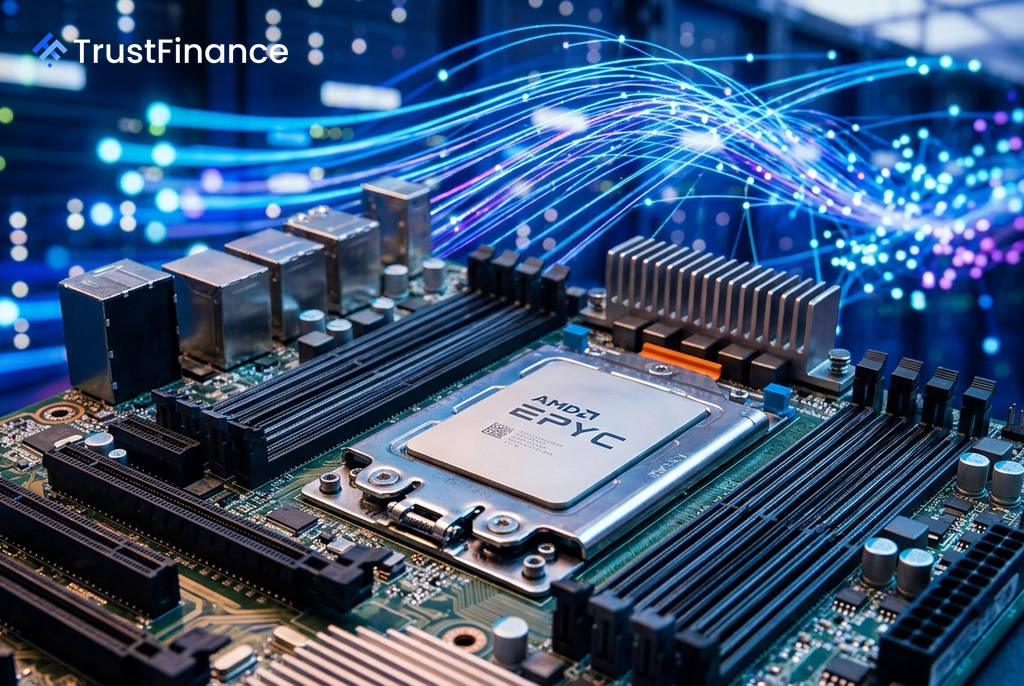
Raymond James upgraded its rating on Advanced Micro Devices (NASDAQ: AMD) to Strong Buy from Outperform on Tuesday, citing a massive potential expansion in the server CPU market driven by artificial intelligence. The firm projects the market will grow at a 44% five-year compound annual rate, reaching approximately $201 billion by 2030.
A New AI Growth Engine
In a note to clients, Raymond James analyst Simon Leopold identified "agentic AI" as the primary new catalyst for growth. The firm defines this as persistent AI agents that generate workloads like orchestration, retrieval, and database tasks, which predominantly run on CPUs.
Unlike traditional AI models, demand for agentic AI scales with the number of active agents and workflow complexity, not just model parameters or token generation. This creates a significant new demand vector for server processors.
Market Breakdown and Competitive Landscape
 Ad
Raymond James's model breaks down the forecasted $201 billion market as follows:
- $85 billion for agentic CPUs
- $83 billion for AI head-end CPUs
- $33.5 billion for conventional datacenter CPUs
The firm's base case is broadly aligned with Nvidia's long-term $200 billion framework and slightly below AMD's own $220 billion estimate. The note stated AMD offers "the strongest combination of direct earnings leverage, datacenter positioning and market-share gains."
By contrast, Raymond James sees Intel (NASDAQ: INTC) remaining exposed to market share loss despite overall market growth. The firm also noted that Arm (NASDAQ: ARM) stands to benefit from server royalty growth and the rise of custom silicon. However, the analysts cautioned that workload growth will not directly translate to a one-for-one increase in chip shipments, as factors like higher utilization and software efficiencies will absorb some of the demand.
Read next
More on Stocks
FTC Orders Walmart, Uber, Delta to Disclose Data on Personalized Pricing
The U.S. Federal Trade Commission is demanding nine major companies, including leading retail, travel, and gig economy firms, to provide information on how they use consumer data for setting individual prices and wages.

Google Launches Gemini 4 Carbon AI Model to Bolster Cybersecurity Capabilities
Alphabet's Google has unveiled Gemini 4 Carbon, its latest AI model specifically designed for advanced cybersecurity tasks like vulnerability detection and secure code generation. The launch escalates competition with rivals OpenAI and Anthropic in the enterprise AI market.

Oracle Shares Surge After Unveiling $225 Billion Revenue Target for 2030
Oracle stock rose sharply after the company presented a long-term financial outlook targeting at least $225 billion in annual revenue by fiscal 2030, driven by its expanding AI infrastructure business.

DOJ Scrutinizes Nvidia's $12.9B Hugging Face Deal Amid Broader Antitrust Probe, Sources Say
The U.S. Department of Justice is reportedly examining Nvidia's planned $12.93 billion acquisition of AI platform Hugging Face as part of a wider, ongoing antitrust investigation into the chipmaker's market conduct.