
Story
Airbus Faces Indefinite Strike in Spain, Jeopardizing Delivery Targets
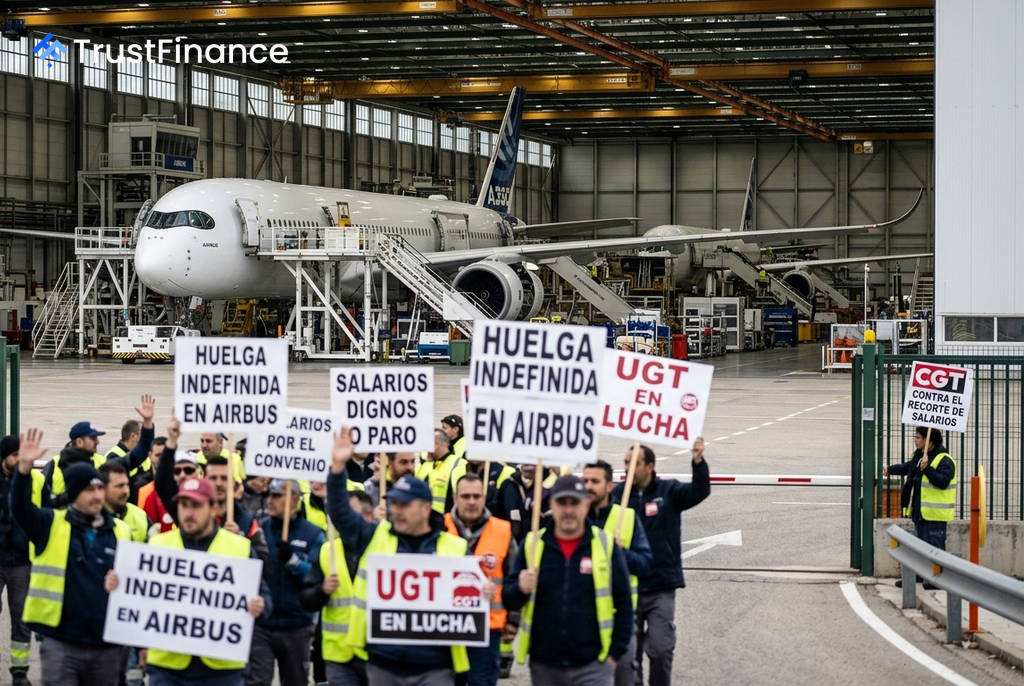
Thousands of Airbus SE workers in Spain have resumed industrial action this week, launching an indefinite strike after rejecting the company's latest pay and conditions proposal. The move escalates a dispute that previously saw 22 days of strikes in July and could create headwinds for the planemaker's production schedule.
Strike Resumes After Failed Mediation
Unions reported that approximately 90% of eligible workers participated in a work stoppage on Tuesday after voting in plant-level assemblies to turn down an offer presented during a mediation session last Friday. The three striking unions represent about 40% of Airbus Spain's workforce of roughly 14,000 employees, according to French unions familiar with the matter. The participation figures could not be independently verified.
Union representatives stated that the company's proposal was inadequate, lacking firm timelines and financial commitments on key issues. A new mediation meeting between the two sides is scheduled for Thursday.
Production and Delivery Risks
The prolonged labor dispute threatens to disrupt operations at a critical time for Airbus, which is under pressure to meet its annual delivery target of 870 jets. Union representatives for UGT and CGT said the stoppage has already slowed both military and commercial production. In response to the strike, Airbus has frozen planned hiring in Spain for the duration of the action, according to Alfonso Mora, head of the Airbus works council in Spain.
 Ad
While Airbus stated last week that disruption to administrative functions had not yet impacted production, the escalation to an indefinite strike by a significant portion of the workforce increases the risk of tangible delays. The company operates eight sites in Spain, which are involved in producing military transport planes and manufacturing parts for commercial aircraft and satellites.
Core Demands and Background
Workers are seeking a package of improved terms amid rising living costs. Key demands from the unions include:
- Inflation-linked pay increases
- Restoration of previous remote-working arrangements
- Improved sick-leave benefits
Unions also cited unresolved issues regarding holidays, flexible hours, and transport arrangements. Following the protests in July, Airbus had already modified its plans to reduce remote work, allowing staff to continue working from home an average of two days per week. The company did not immediately respond to requests for comment on the latest developments.
Read next
More on Stocks
FTC Orders Walmart, Uber, Delta to Disclose Data on Personalized Pricing
The U.S. Federal Trade Commission is demanding nine major companies, including leading retail, travel, and gig economy firms, to provide information on how they use consumer data for setting individual prices and wages.

Google Launches Gemini 4 Carbon AI Model to Bolster Cybersecurity Capabilities
Alphabet's Google has unveiled Gemini 4 Carbon, its latest AI model specifically designed for advanced cybersecurity tasks like vulnerability detection and secure code generation. The launch escalates competition with rivals OpenAI and Anthropic in the enterprise AI market.

Oracle Shares Surge After Unveiling $225 Billion Revenue Target for 2030
Oracle stock rose sharply after the company presented a long-term financial outlook targeting at least $225 billion in annual revenue by fiscal 2030, driven by its expanding AI infrastructure business.

DOJ Scrutinizes Nvidia's $12.9B Hugging Face Deal Amid Broader Antitrust Probe, Sources Say
The U.S. Department of Justice is reportedly examining Nvidia's planned $12.93 billion acquisition of AI platform Hugging Face as part of a wider, ongoing antitrust investigation into the chipmaker's market conduct.