
Story
AI Hardware Stocks Fracture Into Three Tiers, Creating Divergent Trading Outlooks
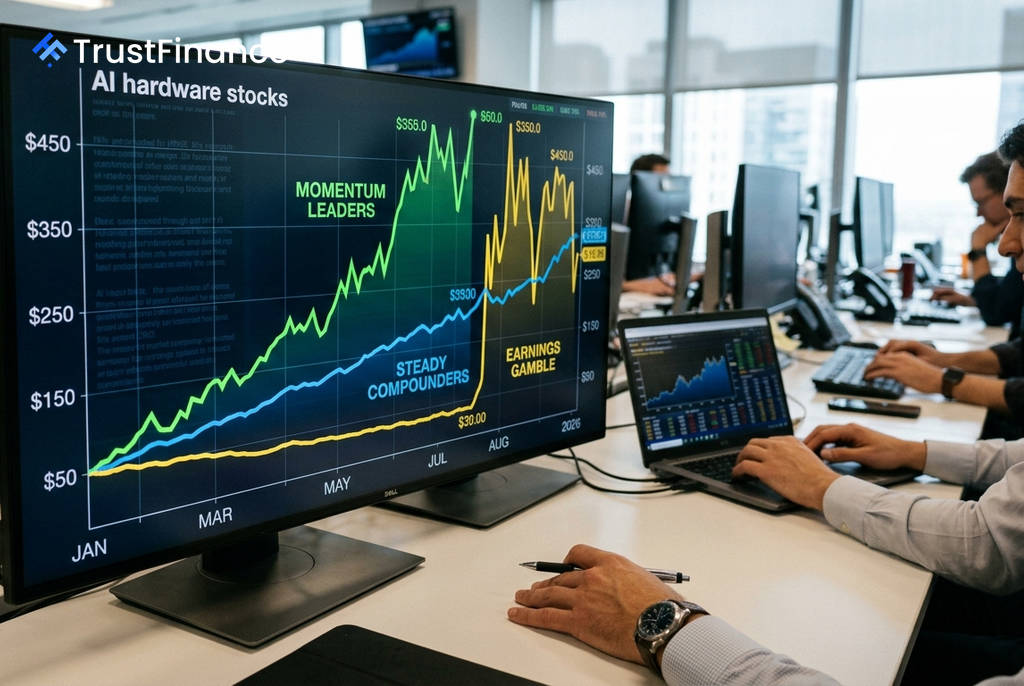
A stark divergence in year-to-date performance has fractured the artificial intelligence hardware sector into three distinct tiers, separating momentum leaders from more stable performers and previously lagging stocks now surging on strong earnings. This split is creating different strategic considerations for investors, with an analysis from Investing.com highlighting the unique technical and fundamental drivers for each group.
A Three-Tiered Market
The performance gap among key players in the AI infrastructure space has become pronounced. Based on market data as of the Aug. 11 close, the stocks have separated into clear categories:
- Tier 1: Momentum Leaders: These stocks have more than doubled in value this year. They include Marvell (MRVL) at +144.8% YTD, Arm Holdings (ARM) at +138.4%, and AMD (AMD) at +116.7%.
- Tier 2: Steady Compounders: This group has posted solid gains without the parabolic moves of the leaders. It includes Arista Networks (ANET) at +47.6%, Broadcom (AVGO) at +17.9%, and NVIDIA (NVDA) at +14.6%.
- Tier 3: The Laggards: Prior to recent earnings, these stocks had significantly underperformed. CoreWeave (CRWV) was up +22.2% YTD, while Super Micro (SMCI) had gained just +5.5%.
Laggards Surge on Earnings Beat
The most immediate action is centered on the third tier, where strong quarterly results have triggered significant upward moves, challenging their laggard status. Both Super Micro and CoreWeave were reportedly heavily shorted heading into their earnings announcements, creating the potential for a short squeeze.
 Ad
Super Micro reported fourth-quarter EPS of $1.70, crushing the consensus estimate of $0.62-$0.96. The company also issued strong fiscal 2027 revenue guidance of $65-72 billion, well above the $52.5 billion estimate, sending its shares up 9.1% in pre-market trading. Similarly, CoreWeave jumped 18.5% pre-market after beating its own second-quarter estimates. According to the analysis, these are event-driven trades, and their ability to break long-term downtrends will depend on whether they can sustain these initial gains.
Leaders and Compounders Offer Different Profiles
The momentum leaders, while showing impressive gains, are exhibiting signs of technical overextension, according to Investing.com's analysis. Stocks like Marvell and AMD have seen substantial pullbacks from recent highs, suggesting profit-taking and demanding disciplined risk management from trend-following investors.
In contrast, the steady compounders like NVIDIA, Broadcom, and Arista Networks are described as having more stable technical foundations. Arista, in particular, was noted for showing a consistent "Strong Buy" signal across daily, weekly, and monthly timeframes. These companies, which provide essential networking and chip components, are seen as benefiting from broad AI data center investment, regardless of which specific chip architectures ultimately dominate.
Read next
More on Stocks
FTC Orders Walmart, Uber, Delta to Disclose Data on Personalized Pricing
The U.S. Federal Trade Commission is demanding nine major companies, including leading retail, travel, and gig economy firms, to provide information on how they use consumer data for setting individual prices and wages.

Google Launches Gemini 4 Carbon AI Model to Bolster Cybersecurity Capabilities
Alphabet's Google has unveiled Gemini 4 Carbon, its latest AI model specifically designed for advanced cybersecurity tasks like vulnerability detection and secure code generation. The launch escalates competition with rivals OpenAI and Anthropic in the enterprise AI market.

Oracle Shares Surge After Unveiling $225 Billion Revenue Target for 2030
Oracle stock rose sharply after the company presented a long-term financial outlook targeting at least $225 billion in annual revenue by fiscal 2030, driven by its expanding AI infrastructure business.

DOJ Scrutinizes Nvidia's $12.9B Hugging Face Deal Amid Broader Antitrust Probe, Sources Say
The U.S. Department of Justice is reportedly examining Nvidia's planned $12.93 billion acquisition of AI platform Hugging Face as part of a wider, ongoing antitrust investigation into the chipmaker's market conduct.