
Story
AI, EVs, and Shipbuilding to Bolster China's Exports, Huachuang Securities Reports
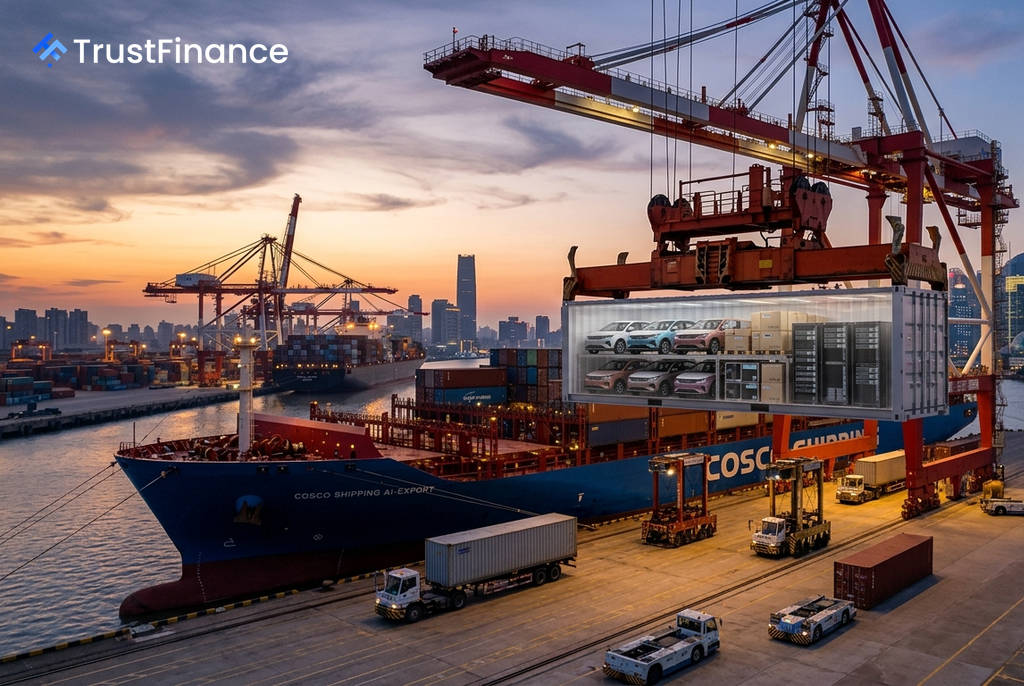
China's exports continued their robust growth trajectory in July, and this strength is expected to persist for the remainder of the year, underpinned by three key industrial chains: artificial intelligence (AI), new energy vehicles (NEVs), and shipbuilding. A research report from Huachuang Securities highlights that these sectors will provide a resilient foundation for the country's trade performance amid a complex global economic landscape.
Key Export Drivers
According to the report, China's exports surged by 23.9% year-over-year in July, bringing the total growth for the first seven months of the year to 18.5%. The analysis identified five primary product categories that were the main engines of this growth, collectively contributing 20.8 percentage points to the July figure and accounting for 87% of the total year-over-year increase.
The primary contributors to July's export growth were:
- AI-related products: Including integrated circuits and automatic data processing equipment, this category added 10.0 percentage points to export growth.
- Other electromechanical products: This broad category, which includes power infrastructure and industrial goods, contributed 5.4 percentage points.
- New energy vehicles: Automotive exports, including chassis, added 2.2 percentage points.
- Other unspecified goods: Primarily chemical and industrial products, this group contributed 2.0 percentage points.
- Shipbuilding: Exports of ships added 1.1 percentage points.
A Deeper Look at Growth Categories
 Ad
Using more detailed customs data available through June, Huachuang Securities provided further insight into the diverse drivers within the broader "other" categories. In the first half of the year, "other electromechanical products" saw strong performance from advanced manufacturing goods like 3D printers and industrial robots, as well as components for the renewable energy sector.
Notably, exports of power generation-related products—including solar cells, wind turbines, and electrical equipment—grew by 28.8% year-over-year from January to June. Meanwhile, the "other unspecified goods" category was bolstered by strong exports of basic organic chemicals, pharmaceuticals, and critical minerals like rare earth products.
Outlook and Market Implications
The report concludes that resilient external demand, combined with the strong competitive positioning of these key industries, will likely support China's export strength in the second half of the year. For investors, this analysis pinpoints specific high-growth segments within China's vast manufacturing and export economy that may continue to outperform.
The findings suggest that despite global economic headwinds, targeted industrial strength in high-tech and green energy sectors provides a powerful buffer. Huachuang Securities also noted that imports related to the AI supply chain are expected to remain elevated, driven by strong export demand for finished tech goods.
Read next
More on Stocks
FTC Orders Walmart, Uber, Delta to Disclose Data on Personalized Pricing
The U.S. Federal Trade Commission is demanding nine major companies, including leading retail, travel, and gig economy firms, to provide information on how they use consumer data for setting individual prices and wages.

Google Launches Gemini 4 Carbon AI Model to Bolster Cybersecurity Capabilities
Alphabet's Google has unveiled Gemini 4 Carbon, its latest AI model specifically designed for advanced cybersecurity tasks like vulnerability detection and secure code generation. The launch escalates competition with rivals OpenAI and Anthropic in the enterprise AI market.

Oracle Shares Surge After Unveiling $225 Billion Revenue Target for 2030
Oracle stock rose sharply after the company presented a long-term financial outlook targeting at least $225 billion in annual revenue by fiscal 2030, driven by its expanding AI infrastructure business.

DOJ Scrutinizes Nvidia's $12.9B Hugging Face Deal Amid Broader Antitrust Probe, Sources Say
The U.S. Department of Justice is reportedly examining Nvidia's planned $12.93 billion acquisition of AI platform Hugging Face as part of a wider, ongoing antitrust investigation into the chipmaker's market conduct.