
Story
AI ETFs Compared: IGPT, ARTY, and AIS Show Divergent Risk-Return Profiles
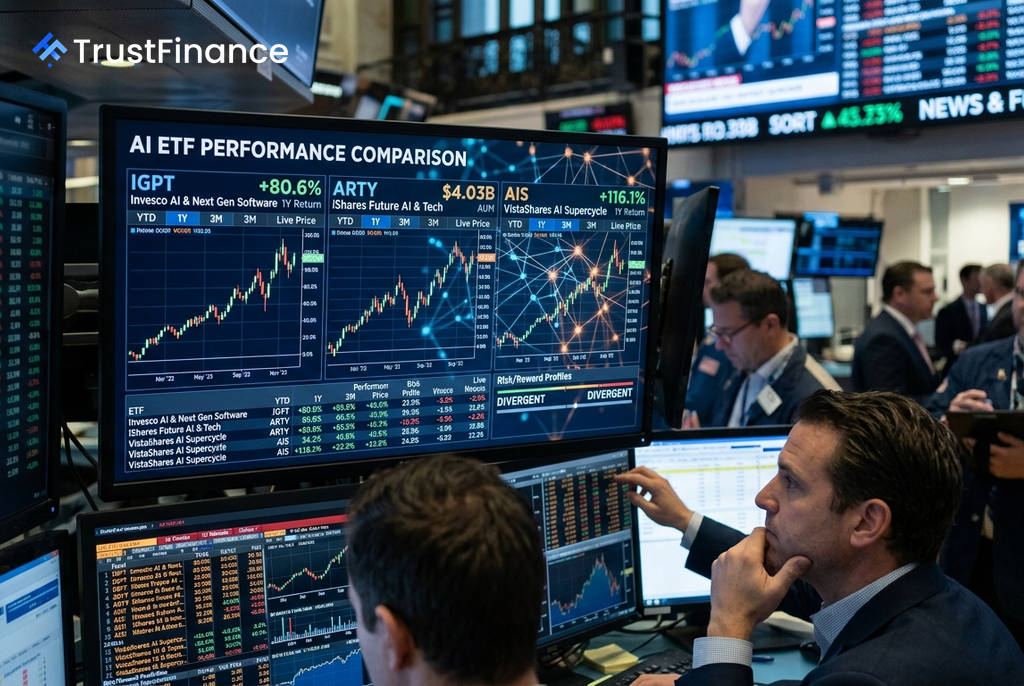
Three leading exchange-traded funds (ETFs) focused on artificial intelligence and software experienced a broad sell-off on September 14, highlighting their distinct strategies and volatility profiles amid wider market pressure. The performance of the Invesco AI & Next Gen Software ETF (IGPT), the iShares Future AI & Tech ETF (ARTY), and the VistaShares AI Supercycle ETF (AIS) showcases the different approaches available for investors seeking exposure to the AI sector.
A Tale of Three Strategies
Each fund offers a unique portfolio construction, catering to different risk appetites and geographic preferences, according to data from Investing.com.
- Invesco AI & Next Gen Software (IGPT): With $1.29 billion in assets under management (AUM), this fund is a concentrated, US-centric bet. Despite its name, it is heavily weighted toward semiconductors, with top holdings including Meta (META), NVIDIA (NVDA), and AMD (AMD). The fund has an 83% North American tilt and has delivered a one-year return of +80.6%.
- iShares Future AI & Tech (ARTY): As the largest of the three with $4.03 billion in AUM, ARTY provides a more globally diversified approach. Its significant liquidity suggests strong institutional interest. The fund balances its domestic holdings with 25.5% exposure to Asia, including companies like TSMC. Its one-year return stands at +70.8%.
- VistaShares AI Supercycle (AIS): This $1.0 billion fund represents the highest-risk, highest-reward option. It has the most aggressive global allocation, with 34% exposure to Asia through holdings like SK Hynix. While it boasts the highest one-year return at +116.1%, its higher beta was evident in the recent session's sharp decline.
Market Volatility Highlights Risk
The September 14 trading session underscored the varying levels of volatility inherent in each ETF's strategy. As of approximately 3:20 PM EDT, all three funds were down, per Investing.com data:
 Ad
- IGPT: -2.44%
- ARTY: -3.42%
- AIS: -6.61%
The steep 6.61% single-day drawdown for AIS, the top performer over the past year, illustrates the potential volatility that accompanies its high-growth strategy. The source noted that the synchronized sell-off suggests the pressure was driven by broader macroeconomic factors or sector rotation rather than news specific to any of the funds.
Key Distinctions for Investors
The comparison reveals a clear trade-off between concentrated bets and diversification. IGPT offers a focused play on US technology leaders, while ARTY provides a more balanced, liquid, and globally diversified portfolio. AIS targets maximum growth through a high-conviction, globally-oriented strategy, which in turn carries higher volatility.
The source also noted the existence of leveraged single-stock ETFs, which have posted even higher returns. However, it clarified these are daily-reset instruments designed for short-term tactical trading and are not suitable for long-term exposure to the AI theme.
Read next
More on Stocks
FTC Orders Walmart, Uber, Delta to Disclose Data on Personalized Pricing
The U.S. Federal Trade Commission is demanding nine major companies, including leading retail, travel, and gig economy firms, to provide information on how they use consumer data for setting individual prices and wages.

Google Launches Gemini 4 Carbon AI Model to Bolster Cybersecurity Capabilities
Alphabet's Google has unveiled Gemini 4 Carbon, its latest AI model specifically designed for advanced cybersecurity tasks like vulnerability detection and secure code generation. The launch escalates competition with rivals OpenAI and Anthropic in the enterprise AI market.

Oracle Shares Surge After Unveiling $225 Billion Revenue Target for 2030
Oracle stock rose sharply after the company presented a long-term financial outlook targeting at least $225 billion in annual revenue by fiscal 2030, driven by its expanding AI infrastructure business.

DOJ Scrutinizes Nvidia's $12.9B Hugging Face Deal Amid Broader Antitrust Probe, Sources Say
The U.S. Department of Justice is reportedly examining Nvidia's planned $12.93 billion acquisition of AI platform Hugging Face as part of a wider, ongoing antitrust investigation into the chipmaker's market conduct.