
Story
AI Demand to Accelerate Growth for PCB, Laminate Suppliers in H2, Sinolink Says
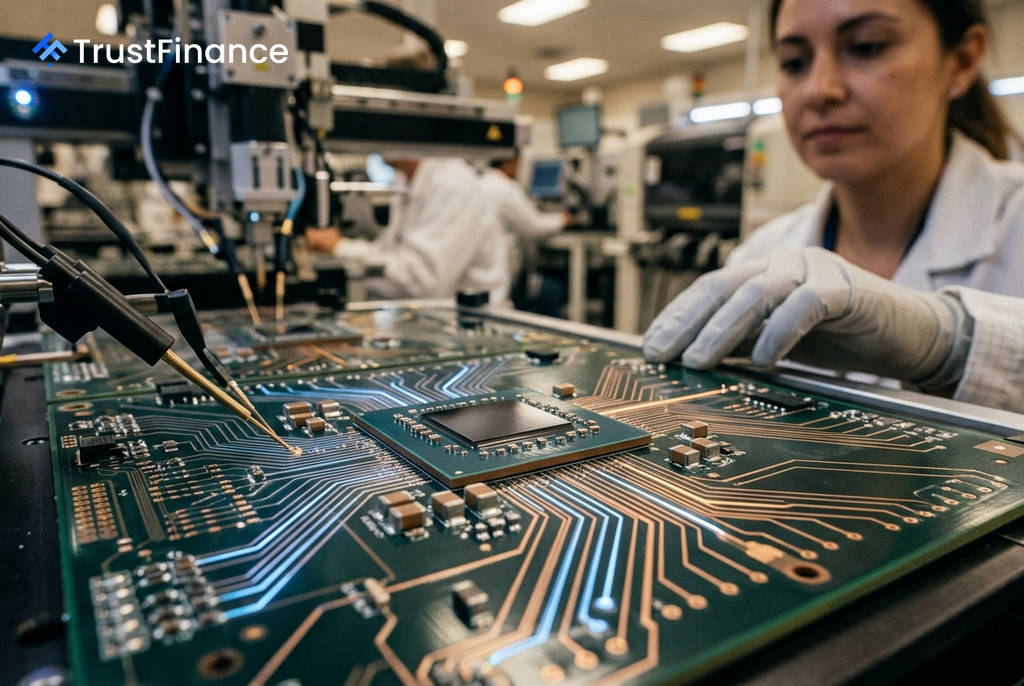
Surging demand for artificial intelligence hardware is set to accelerate sequential earnings growth for manufacturers of Printed Circuit Boards (PCBs) and Copper Clad Laminates (CCLs) in the second half of the year, according to a new research note from Sinolink Securities. The brokerage firm notes that many AI-related PCB companies are already operating at full capacity amid strong order books and are actively expanding production to meet the demand.
New Product Cycles to Boost Value
Sinolink states that while the first half of the year saw strong orders for general AI-related hardware like switch and server motherboards, the second half will mark a peak pull-in period for higher-value components tied directly to new GPUs and TPUs. This transition is expected to significantly increase the revenue contribution per unit.
The report highlights a substantial increase in the value of these next-generation boards. Key examples include:
- PCBs for Nvidia's upcoming Rubin platform, which are expected to see a value increase of over 100% per GPU compared to the current GB-series.
- Boards for Google's TPU V8 series, which could see a value increase of more than 400% over their predecessors.
Furthermore, the note points to AMD's Helios platform as another key contributor. The platform has reportedly gained strong traction with customers including Meta, Microsoft, and OpenAI, with initial shipments anticipated by the end of Q3 and a significant volume ramp-up in Q4.
Supply Chain Bottlenecks and Expansion
 Ad
The robust demand is creating bottlenecks in the supply chain, particularly for high-end materials. Sinolink points to a growing demand for AI-specific Copper Clad Laminates (CCLs), a foundational material for PCBs. With overseas CCL manufacturers expanding production slowly, shortages and price increases are becoming more common, creating an opportunity for leading suppliers in mainland China to benefit.
Demand is also described as "exploding" for PCBs using the modified semi-additive process (mSAP) required for 800G and 1.6T optical modules. The report notes that capacity in this segment is severely constrained, prompting several manufacturers to announce significant production expansions. Demand for high-layer count PCBs for 1.6T switches is also expected to begin in the second half of the year.
Big Tech Capex Signals Sustained Demand
The optimistic outlook is supported by rising capital expenditures (CAPEX) from major North American cloud service providers (CSPs), who are the primary consumers of AI hardware. Sinolink cited recent earnings calls where several tech giants, including Google and Meta Platforms, revised their 2026 spending forecasts upward.
Microsoft also projected its CAPEX for the next quarter would exceed $50 billion, a substantial increase from the prior quarter, with its full-year FY2027 spending also expected to grow. This sustained investment from major end-users signals strong, long-term demand, leading Sinolink to maintain a positive view on the entire AI hardware supply chain, from PCBs and CCLs to core computing components and semiconductor equipment.
Read next
More on Stocks
FTC Orders Walmart, Uber, Delta to Disclose Data on Personalized Pricing
The U.S. Federal Trade Commission is demanding nine major companies, including leading retail, travel, and gig economy firms, to provide information on how they use consumer data for setting individual prices and wages.

Google Launches Gemini 4 Carbon AI Model to Bolster Cybersecurity Capabilities
Alphabet's Google has unveiled Gemini 4 Carbon, its latest AI model specifically designed for advanced cybersecurity tasks like vulnerability detection and secure code generation. The launch escalates competition with rivals OpenAI and Anthropic in the enterprise AI market.

Oracle Shares Surge After Unveiling $225 Billion Revenue Target for 2030
Oracle stock rose sharply after the company presented a long-term financial outlook targeting at least $225 billion in annual revenue by fiscal 2030, driven by its expanding AI infrastructure business.

DOJ Scrutinizes Nvidia's $12.9B Hugging Face Deal Amid Broader Antitrust Probe, Sources Say
The U.S. Department of Justice is reportedly examining Nvidia's planned $12.93 billion acquisition of AI platform Hugging Face as part of a wider, ongoing antitrust investigation into the chipmaker's market conduct.