
Story
AI Capex Growth to Decelerate Into a 'Soft Landing,' Wolfe Research Forecasts
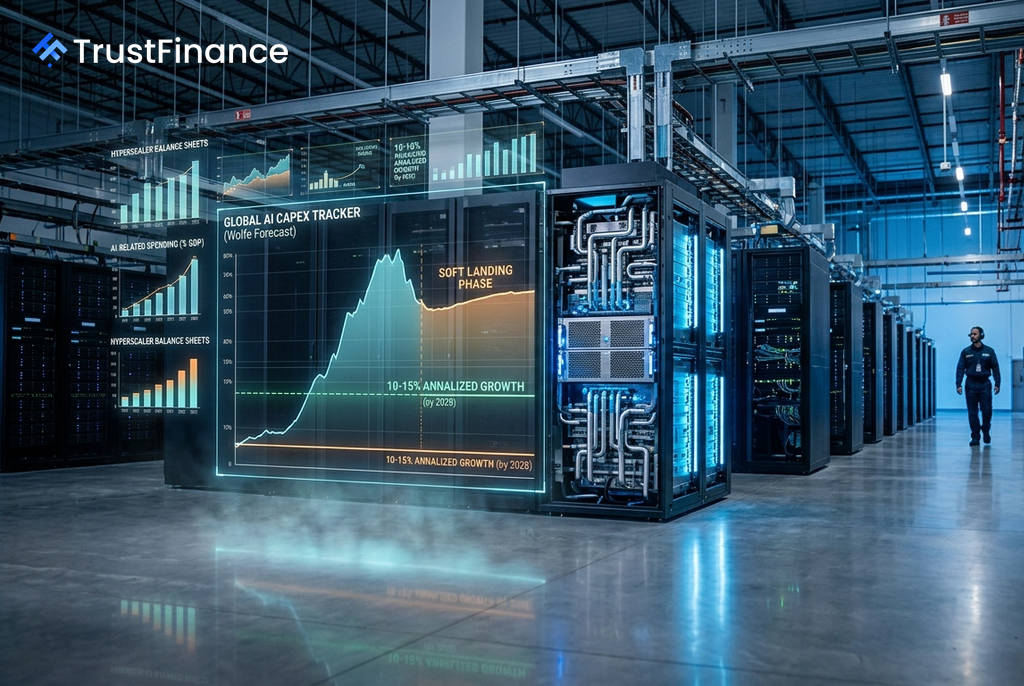
The unprecedented surge in capital spending on artificial intelligence is poised to decelerate from its current breakneck pace, but the slowdown is likely to be an orderly "soft landing" rather than a sharp collapse, according to a recent analysis by Wolfe Research.
The Decelerating Boom
AI-related capital expenditure (capex) is on track for approximately 40% growth in 2026, with consensus forecasts projecting another 30% increase for hyperscaler spending in 2027, the Wolfe Research note stated. This represents a moderation from the peak quarter-over-quarter growth rates that exceeded 80% in early 2022.
Wolfe Research's base case scenario sees this deceleration continuing, with annualized growth settling into a more sustainable 10%-15% range by 2028. This managed slowdown is supported by strong hyperscaler balance sheets, a deep pipeline of projects, and ongoing competitive pressures to invest in AI infrastructure.
Economic Footprint
The scale of this investment cycle has been immense. Domestic AI-related spending—encompassing equipment, software, R&D, and data centers—has surged from almost nothing in 2021 to roughly 2% of GDP as of the second quarter, according to the report. Wolfe noted this trajectory makes it one of the fastest investment booms in recent history, outpacing both the dot-com buildout of the late 1990s and the housing cycle of the mid-2000s on a capex-to-GDP basis.
 Ad
This spending has been a significant economic driver, contributing 10%-20% of nominal GDP growth in recent quarters. The physical buildout continues, with FracTracker data cited by Wolfe showing more than 700 data centers in the pipeline, which would expand the existing stock by 16%. However, the report highlights that the primary economic benefits, such as job and wage growth, are concentrated in the multi-year construction phase, with operational data centers employing far fewer permanent staff.
Navigating Market Risks
Wolfe Research identified a potential risk that could turn the orderly deceleration into a disorderly one: a significant equity repricing in hyperscale tech companies. These firms are not only the biggest capex spenders but also hold a dominant share of the S&P 500's market capitalization, creating what the note calls a "circularity risk" where falling stock prices could hit the wealth effect and force accelerated spending cuts.
This risk scenario would likely be triggered by a combination of disappointing AI revenue growth and broader market multiple compression. Citing The Economist, the report pointed to a current gap where estimated AI service revenues of around $200 billion are dwarfed by capex estimates more than three times that size. While Wolfe expects this gap to narrow, a failure to do so could heighten market sensitivity. Still, the firm emphasized this is not its base case, concluding, "A risk is the market, not the technology itself."
Read next
More on Stocks
FTC Orders Walmart, Uber, Delta to Disclose Data on Personalized Pricing
The U.S. Federal Trade Commission is demanding nine major companies, including leading retail, travel, and gig economy firms, to provide information on how they use consumer data for setting individual prices and wages.

Google Launches Gemini 4 Carbon AI Model to Bolster Cybersecurity Capabilities
Alphabet's Google has unveiled Gemini 4 Carbon, its latest AI model specifically designed for advanced cybersecurity tasks like vulnerability detection and secure code generation. The launch escalates competition with rivals OpenAI and Anthropic in the enterprise AI market.

Oracle Shares Surge After Unveiling $225 Billion Revenue Target for 2030
Oracle stock rose sharply after the company presented a long-term financial outlook targeting at least $225 billion in annual revenue by fiscal 2030, driven by its expanding AI infrastructure business.

DOJ Scrutinizes Nvidia's $12.9B Hugging Face Deal Amid Broader Antitrust Probe, Sources Say
The U.S. Department of Justice is reportedly examining Nvidia's planned $12.93 billion acquisition of AI platform Hugging Face as part of a wider, ongoing antitrust investigation into the chipmaker's market conduct.