
Story
Oil Prices Ease as Ceasefire Hopes Temper Middle East Supply Risks
Summary
Oil benchmarks dipped from one-month highs as reports of diplomatic efforts between the U.S. and Iran overshadowed fresh military strikes and new threats to Saudi Arabian shipping.
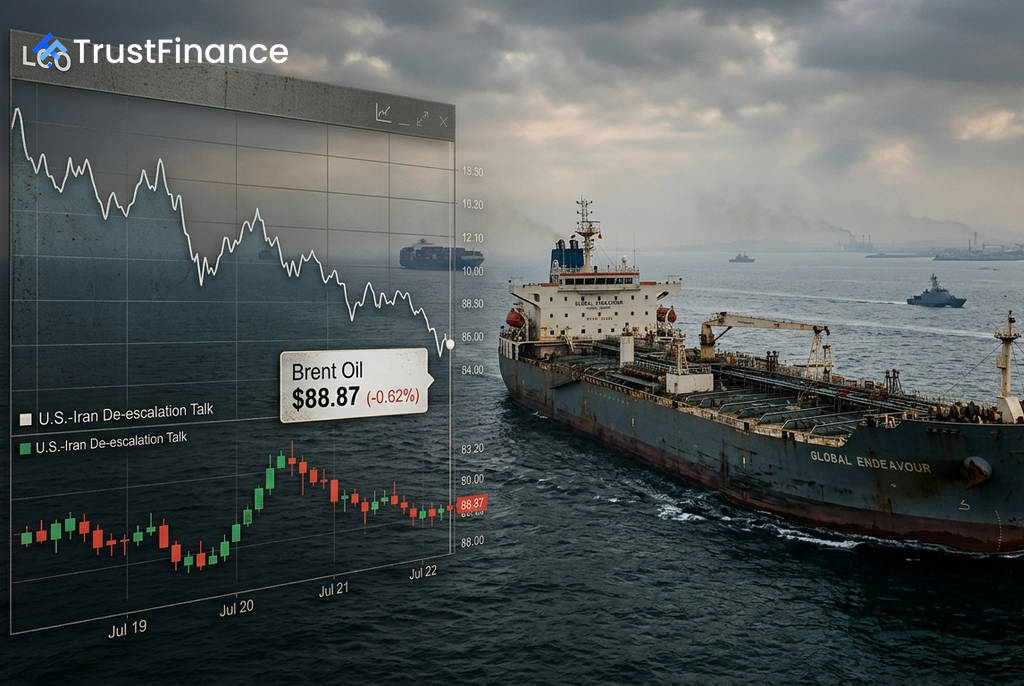
Oil prices retreated from recent highs on Tuesday as the market weighed reports of potential ceasefire talks between the U.S. and Iran against ongoing military exchanges and new threats to critical Middle East supply routes.
Market Snapshot
Benchmark crude contracts pulled back from their highest levels in over a month, which were reached in the previous session. As of 0052 GMT, prices were reported as follows:
- Brent crude futures declined 35 cents, or 0.4%, to $88.87 per barrel.
- U.S. West Texas Intermediate (WTI) crude for September delivery held steady at $82.47 a barrel.
Conflicting Geopolitical Signals
The slight downturn in prices followed a report from Reuters, citing a senior Iranian official, that Tehran had received a proposal from mediators for a 10-day ceasefire. The diplomatic push aims to salvage an interim deal and de-escalate a conflict that has included U.S. strikes on Iranian cities and retaliatory attacks by Iran's Revolutionary Guards on U.S. assets.
 Ad
Ad"The overnight talk of de-escalation and peace talks appears to be capping the upside for the time being," IG market analyst Tony Sycamore said in a note, according to Reuters. He added that it "remains to be seen" if the talks will yield results.
Heightened Supply Risks
However, significant supply-side risks continue to underpin the market. On Monday, Yemen's Iran-aligned Houthis announced they would impose a naval blockade on Saudi Arabia, a move that threatens to disrupt shipments from another major global oil producer.
"The threats of a naval blockade on Saudi Arabia by the Houthis are significant because they raise the risk of disruption to another major oil exporter," Tim Waterer, chief market analyst at KCM Trade, told Reuters. The potential for a new front in the regional conflict comes as U.S. Central Command confirmed it had begun another round of strikes on Iran, highlighting the fragile security situation.
Read next
More on Commodities
Copper Price Stalls at Key Fibonacci Resistance Near $6.70
Copper futures are facing a significant technical test at the 61.8% Fibonacci retracement level around $6.70, with overbought signals and fading volume creating uncertainty after a recent V-shaped recovery.

Silver Price Stalls at $68 Resistance Amid Bull Trap Warnings
Silver is testing the critical $68.00 resistance level, but technical indicators show weakening momentum and fading volume, raising the risk of a potential 'bull trap' for traders.

Brent Crude Tests Critical $103 Support Amid Conflicting Technical Signals
Brent oil futures are trading at a pivotal technical juncture around $103 per barrel, where a key support indicator is being tested. A breakdown could accelerate losses, while a successful defense may spark a rebound from oversold conditions.

Gold Prices Confined to Narrow Range as Technical Indicators Signal Indecision
Gold is trading within a tight band defined by significant technical support and resistance levels, as conflicting chart signals and declining volume point to a period of consolidation before a potential breakout.